
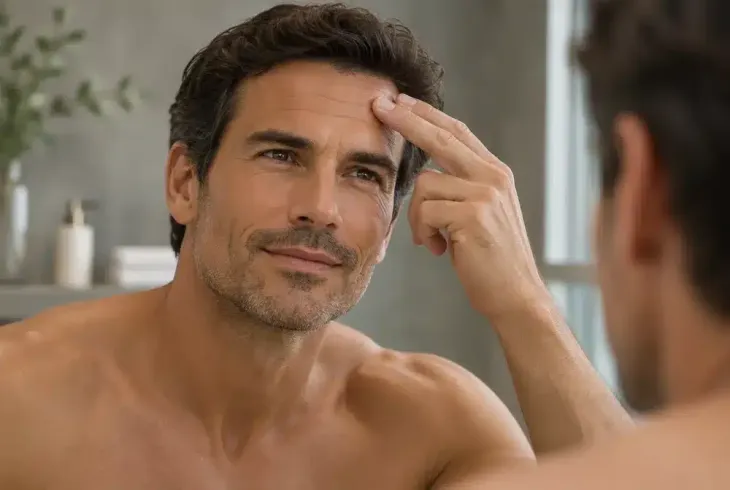
Botox for men works the same way it does for women, relaxing the muscles that crease the forehead, the frown lines between the brows and crow’s feet, but men often need a higher dose and a different placement. Stronger facial muscles usually call for more units, and a skilled injector keeps the brow flat and natural so you look rested, not “done.”
The essentials
- Men often need more units than women. In a dose study by Drs. Jean and Alastair Carruthers, men treated for frown lines did better on 40, 60 or 80 units than on 20 units, as summarized by MDedge Dermatology.
- Placement matters as much as dose: injectors usually avoid lifting or arching a man’s brow to keep a straight, masculine shape.
- Results build over days, and the effect typically wears off over a few months, so maintenance visits are part of the plan.
- Common areas include the forehead, the 11 lines, crow’s feet and, for jaw clenching or a wider lower face, the masseter muscles.
- Botox is available at all seven Esthetica Medspa locations, with a consultation before every first treatment.
Why do men get Botox?
Most men get Botox for the same reason women do: to soften expression lines that make them look tired, stressed or older than they feel. Frown lines, forehead lines and crow’s feet are the most common requests, and many men simply want to look rested at work without anyone being able to tell why.
Men have been part of the neuromodulator story for a long time. MDedge reported that botulinum toxin was the most common minimally invasive cosmetic procedure performed in men, with more than 385,000 treatments in a single year and a 310 percent increase since 2000. Our guide to Botox before and after shows the kind of subtle change most people are after.
The goal for most men is not a frozen look. It is fewer deep lines when the face is at rest, while still being able to show concern, focus and humor. That outcome depends on the dose and on where the product goes.
Do men need more Botox units than women?
Often, yes. Men tend to have larger, stronger facial muscles, and research on frown lines found that men responded better to higher doses. The exact number depends on your muscles, the area and how much movement you want to keep, which is why units are set in person rather than from a chart.
The best-known evidence comes from Drs. Jean and Alastair Carruthers. In a study of 80 men treated for glabellar (frown) lines, doses of 40, 60 and 80 units were more effective than 20 units, according to MDedge. Reporting on their earlier presentation at the American Academy of Dermatology meeting, HealthDay quoted the researchers saying men need a dose at least twice as high as women to see results, with no added side effects at the higher doses.
Those studies are older, and practice has moved on, but the principle still guides injectors: start with a dose matched to muscle strength and adjust at a follow-up. For a broader look at dosing by area, read Botox units explained: how many by area.
Where do men get Botox?
The most common areas for men are the frown lines between the brows, horizontal forehead lines and crow’s feet. Some men also treat the masseter muscles for jaw clenching or a wider lower face. Each area has its own dosing and its own risks of looking unnatural if over-treated.
| Area | What it treats | What a man-specific approach looks for |
|---|---|---|
| Glabella (11 lines) | Vertical frown lines between the brows | Higher doses were more effective in men in the Carruthers dose study (MDedge) |
| Forehead | Horizontal lines when raising the brows | Keeping a flat, low brow and avoiding a raised or arched shape |
| Crow’s feet | Lines at the outer corners of the eyes | Softening without changing the smile |
| Masseter | Jaw clenching and a bulky jaw muscle | Balancing slimming with a strong, square jawline |
Source for dosing findings: MDedge, Botulinum toxin for men. Units for your face are decided at your appointment.
Area-by-area guides go deeper: Botox for forehead lines and masseter Botox for jaw clenching and slimming.
How do you keep Botox natural-looking for men?
A natural result for men comes from placement and restraint. Men usually have a flatter, lower brow, so injectors avoid patterns that lift or arch it. MDedge describes placing forehead injections higher above the outer brow in men to avoid a lifted look. Softening lines rather than erasing all movement also keeps expressions familiar.
The most common reasons Botox looks obvious on a man are a peaked or “surprised” brow, a forehead that cannot move at all, or a heavy, droopy feel from too much product low on the forehead. Each of these is about technique. When you meet your injector, it is reasonable to ask:
- How will you keep my brow shape masculine?
- How much movement will I still have?
- Will you start conservatively and adjust at a follow-up?
- Who will inject me, and what training do they have?
If you want to know more about who should be holding the syringe, our article on how to choose a qualified medspa injector covers credentials and red flags.
What should men ask in a Botox consultation?
Come in with your goal and your concerns, and expect questions back. A good consultation covers which lines bother you, your medical history and medications, any past injectable treatments, and how much movement you want to keep. It should end with a clear plan, a unit estimate and what follow-up looks like.
- Your priority area. Starting with one area, often the frown lines, lets you see how you respond.
- Health history. Tell your provider about neuromuscular conditions, medications, blood thinners, allergies and any recent illness.
- Timing. If you have a work event, a wedding or photos coming up, plan ahead so results have time to settle.
- Maintenance. Ask how often you would likely return and how your plan may change over time.
Plan on a first visit that is a little longer than later ones. Your provider will usually ask you to frown, raise your brows and squint so they can see how each muscle moves, and may take photos to compare at follow-up. Many men find it useful to start conservatively, return for a follow-up once results have settled, and fine-tune from there. That approach takes slightly more time up front, but it builds a dose you can rely on at future appointments and lowers the chance of a result that feels too strong.
How long does Botox last for men?
Results usually begin to show within a few days and keep developing over the following days. The effect then fades gradually over a few months as the muscle regains movement. Men with stronger muscles may notice movement returning sooner, which is one reason dose and follow-up matter.
Timelines vary from person to person, and factors such as dose, area and metabolism all play a part. Our guide to how long Botox lasts explains the typical timeline and what affects it.
What are the side effects of Botox for men?
Side effects are usually mild and short-lived: pinpoint redness, slight swelling or a small bruise at injection sites, and sometimes a mild headache. Less often, the product can affect a nearby muscle and cause a temporary eyelid or brow droop. Choosing an experienced injector and following aftercare reduces these risks.
Seek medical help right away for rare but serious symptoms such as trouble swallowing, speaking or breathing, or muscle weakness away from the treated area. Bruising can be more noticeable in men who take blood thinners or supplements that affect bleeding, so mention them at your consultation. After treatment, our Botox aftercare guide covers what to do and avoid in the first hours and days.
Is Botox for men worth it?
For many men it is a low-commitment way to look less tired or tense, with no downtime and results that fade if you decide not to continue. It is worth it if your goal is softer lines while keeping a natural, masculine expression, and you are comfortable with maintenance visits a few times a year.
It is not the right tool for everything. Botox relaxes muscles, so it softens lines caused by movement. It does not add volume, lift sagging skin or change skin texture. For deep folds or lost volume, dermal fillers or skin treatments may be a better match, and our guide to Botox vs fillers explains the difference.
Botox for men at Esthetica Medspa
Botox is offered at all seven Esthetica Medspa locations. Every first treatment starts with a consultation where your provider assesses your muscles at rest and in motion, sets a dose for your face and explains how they will keep your look natural. Learn more on our Botox service page, then book a consultation at the location nearest you.
Frequently asked questions
Is Botox for men different from Botox for women?
The product is the same, but the plan often differs. Men tend to have stronger muscles that may need more units, and injectors place product to keep a flatter, lower brow so the result looks natural on a male face.
How many units of Botox do men need?
It depends on the area and your muscle strength. In a frown-line study, men did better on 40 to 80 units than on 20 units. Your injector sets your dose in person and can adjust it at a follow-up.
Will people be able to tell I had Botox?
With conservative dosing and good placement, most people only notice that you look rested. Obvious results usually come from over-treatment or a lifted brow, which is why technique and an honest consultation matter.
Does Botox hurt for men?
Most people feel quick pinches from a very fine needle and mild stinging. Appointments are short, and you can usually return to work the same day.
Can Botox help with jaw clenching?
Botox in the masseter muscles is used to reduce clenching and can slim a bulky jaw muscle. A provider will assess whether you are a candidate and how to keep a strong jawline.
When should men start Botox?
There is no set age. Some men start when expression lines begin to stay visible at rest, while others prefer to wait. A consultation can help you decide whether treatment fits your goals.


