
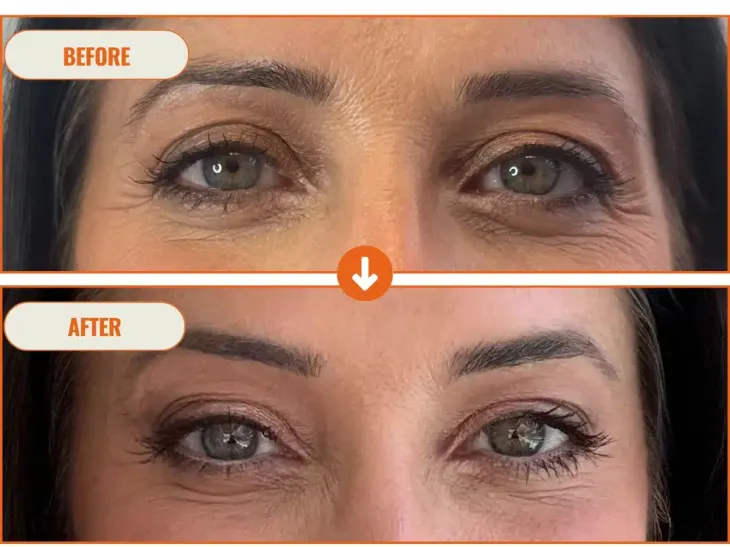
Botox before and after results usually show softer, smoother expression lines rather than a different-looking face. Lines that form when you frown, squint or raise your brows look noticeably relaxed within about a week, while you still look like yourself. The photos below are real Esthetica Medspa patients, shared with their written consent, and every result is individual.
The essentials
- What changes: dynamic lines, the ones caused by muscle movement, on the forehead, between the brows and around the eyes.
- When: the American Society of Plastic Surgeons says results show within a few days, with the full effect taking up to a week, and typically last about three to four months.
- What does not change much: deep lines etched into the skin at rest, volume loss and sagging, which usually need other treatments.
- Doses on label: 20 units for frown lines, 24 for crow’s feet and 40 for forehead lines treated with frown lines, per the Botox Cosmetic prescribing information.
- Real photos: every before-and-after on this page is an Esthetica Medspa patient who consented to share it. Results vary.
What does Botox look like before and after?
Before treatment, expression lines deepen every time the muscle underneath contracts. After Botox, that muscle relaxes, so the lines soften when you move and look smoother at rest. A good result looks rested and natural: you can still smile and show expression, with less creasing in the treated area.
Botox Cosmetic (onabotulinumtoxinA) is a botulinum toxin type A injection that temporarily blocks the nerve signal that tells a muscle to contract. It is FDA-approved for moderate to severe frown lines, crow’s feet, forehead lines and platysma bands in adults. The change is gradual over several days, which is why the most honest “after” photo is taken around two weeks after treatment, once the result has fully settled.
Forehead lines before and after
Forehead lines are the horizontal creases that form when you raise your eyebrows. After treatment, the forehead looks smoother when you lift your brows and at rest, while a skilled injector keeps enough movement to avoid a heavy or flat look. On the Botox Cosmetic label, forehead lines are treated together with frown lines at 40 units in total.
Forehead results depend heavily on brow position. Because the forehead muscle helps lift the brows, treating it too strongly can make them feel low. That is why providers often treat the forehead and the frown lines together and adjust the dose to your brow shape. Read more in our guide to Botox for forehead lines.
Frown lines (the “11s”) before and after
Frown lines, the vertical “11s” between the brows, often show the clearest before-and-after change. Once the muscles that pull the brows together relax, the lines soften both when you frown and at rest. The label dose for frown lines is 20 units, given across five injection points.
If the 11s have been there for years, they may be partly etched into the skin. Botox softens the movement that deepens them, and many patients see the etched part fade further over repeated treatments, but some cases also benefit from skin treatments or filler. Our page on Botox for frown lines covers what to expect.
Crow’s feet before and after
Crow’s feet are the fan of lines at the outer corner of the eyes when you smile or squint. After Botox, those lines look softer when you smile, while the smile itself stays natural. This is what most people mean when they search for Botox before and after for the eyes. The label dose is 24 units, split between both sides.
Lines directly under the eye are a different story. They are often caused by thin skin, volume loss or dryness rather than muscle movement alone, and the under-eye area is not an FDA-approved Botox area. We assess it carefully and often recommend other approaches. See our guide to crow’s feet Botox for more.
Full face Botox before and after: what is realistic?
Full face Botox usually means treating the forehead, frown lines and crow’s feet in one visit, sometimes with other areas. The before-and-after looks like a refreshed version of you, with smoother upper-face lines and a more rested expression, not a change in facial structure.
Some patients also ask about the jawline. Botox for jawline slimming (the masseter muscle) is offered at our locations, but it is an off-label use, and its before-and-after changes slowly over weeks as the muscle relaxes. Our masseter Botox guide explains that timeline.
How long after Botox do you see the “after”?
Most people notice a change within a few days, and the full result shows at about one to two weeks. The ASPS says botulinum toxin results can appear within a few days, can take up to a week for the full effect, and typically last about three to four months.
| Time after treatment | What you usually see |
|---|---|
| Same day | Small bumps at injection points that settle within hours; no visible result yet |
| Days 2 to 5 | Movement starts to soften |
| About 1 to 2 weeks | Full result; the best point to take your “after” photo and assess any touch-up |
| Around 3 to 4 months | Movement gradually returns; lines start to reappear |
Sources: American Society of Plastic Surgeons, Botox Cosmetic prescribing information.
For a full breakdown of what shortens or extends results, read how long Botox lasts.
What can Botox not change?
Botox treats lines caused by muscle movement. It does not restore lost volume, lift sagging skin, or erase lines that are deeply etched at rest, which is why some before-and-after photos online can set unrealistic expectations.
- Static lines: creases visible with the face fully relaxed often improve only partly. Skin treatments such as microneedling, or filler in some areas, may help.
- Volume loss: hollow cheeks, deep smile lines or thinning lips call for dermal fillers, not neurotoxin.
- Skin texture and sun damage: spots, redness and rough texture respond to skin treatments, not Botox.
- Sagging: loose skin on the lower face and neck may need skin tightening or a surgical consultation.
We tell you at consultation which of your concerns Botox can realistically improve, and which need a different plan.
How do you judge Botox before and after photos?
A trustworthy before-and-after shows the same person, same lighting, same angle and the same expression, with the “after” taken one to two weeks after treatment. Compare expression to expression: a frowning “before” next to a relaxed “after” exaggerates the result.
- Matched expression. Look for both photos frowning, smiling or raising the brows in the same way.
- Same lighting and camera distance. Strong flash or soft light can hide lines.
- No filters or retouching. Smooth, poreless skin in the “after” is a warning sign.
- Clear timing. A reputable caption tells you when the photo was taken.
- Real patients with consent. Stock images and AI-generated faces are not evidence of a practice’s work.
Every photo on this page is an Esthetica Medspa patient, taken under consistent conditions and published with written consent.
What affects your Botox result?
Your result depends on your anatomy, the depth of your lines, the dose and the skill of the injector more than on any single product. Strong muscles may need a higher dose or wear off sooner, and very expressive habits can shorten the result. Dose matters too: our guide to Botox units by area walks through typical ranges.
Safety is part of a good result. Common side effects include injection-site discomfort, headache and, less often, a temporary drooping of the brow or eyelid. The Botox Cosmetic label carries a boxed warning that the toxin’s effect may spread beyond the injection area, which can cause swallowing or breathing difficulty. Those serious effects are rare at cosmetic doses, and they are why treatment should be given only by trained providers under medical oversight. Botox is not recommended during pregnancy or breastfeeding, or for people with certain neuromuscular conditions.
Botox at Esthetica Medspa
Esthetica Medspa is a women-led medical spa group with seven locations in Tampa and Lakeland, Florida; San Antonio, Texas; Louisville and Bellevue, Kentucky; King of Prussia, Pennsylvania; and Newark, Delaware. Botox is offered at every location, for areas including forehead lines, frown lines and crow’s feet, with jawline slimming available at many locations.
At your consultation, your provider watches how your face moves, takes standardized “before” photos, and plans the dose with you. We invite you back about two weeks later to take your “after” in the same conditions and adjust if needed. Explore Botox at Esthetica Medspa or see current pricing on our promotions page. Results vary from person to person.
Frequently asked questions
How soon will I see my Botox results?
Most people notice a change within a few days. The ASPS says the full effect can take up to a week, so judge your result at about one to two weeks.
Will Botox make me look frozen?
Not when it is dosed well. A natural result softens lines while keeping expression. Tell your provider how much movement you want to keep; dosing can be adjusted.
How long does a Botox result last?
Typically about three to four months, according to the ASPS. Movement returns gradually, and many patients schedule their next visit as lines start to reappear.
Can Botox fix lines under the eyes?
Usually not well. Under-eye lines are often caused by thin skin or volume loss, and that area is not an FDA-approved Botox area. Crow’s feet at the outer eye are approved and respond well.
Are the before-and-after photos real?
Yes. Every photo on this page is an Esthetica Medspa patient who gave written consent to share it. Results vary, and your provider can show you more examples at consultation.
Can I take my own before and after photos?
Yes, and we encourage it. Use the same spot, light and expression before treatment and again at two weeks for the fairest comparison.
Ready to see your own before and after? Book a consultation at your nearest Esthetica Medspa.
Sources
- https://drugs.com/pro/botox-cosmetic.html
- https://www.plasticsurgery.org/cosmetic-procedures/botulinum-toxin/results
Reviewed for accuracy against the sources above on 10/26/2026. This article is for general information and is not medical advice; your provider will recommend what is right for you.


