
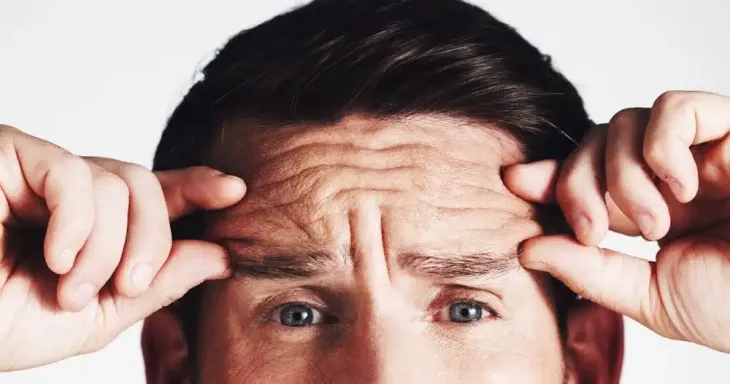
Botox for forehead lines relaxes the frontalis muscle so the horizontal lines across your forehead soften, and the FDA label treats it as a 40-unit job, not a 20-unit one. That number surprises people. The approval covers forehead lines treated together with the frown lines between the brows, because treating the forehead on its own can let the brow drop. Here is what the label says, how many units each zone takes, what it costs, and how to tell a good result from a heavy one.
Updated October 5, 2026 by the Esthetica Medspa clinical team.
The essentials
- Botox Cosmetic has been FDA-approved for moderate to severe forehead lines since October 3, 2017.
- The label dose is 40 units in total: 20 units across the forehead plus 20 units in the glabellar (frown line) area, treated in the same session.
- Forehead injections are 4 units at each of 5 points in the frontalis muscle.
- Onset is usually 3 to 7 days, with the full effect around two weeks and a repeat at roughly three to four months.
- Treating the forehead alone, without the glabella, is the most common cause of a heavy or dropped brow.
What causes horizontal forehead lines?
Horizontal forehead lines come from the frontalis, the broad muscle that lifts your eyebrows. Every time you raise your brows, the skin above them folds; over years those folds become etched lines that stay visible at rest. Sun exposure and thinning collagen make them set in faster, which is why two people of the same age can have very different foreheads.
The frontalis is also the only muscle that lifts the brow. Everything around it pulls down. That single fact explains most of what follows, including why dosing is a balancing act rather than a maximum.
Is Botox FDA-approved for forehead lines?
Yes. The FDA approved Botox Cosmetic for the temporary improvement in the appearance of moderate to severe forehead lines on October 3, 2017, fifteen years after the original glabellar line approval in April 2002. The approval is specifically for forehead lines treated in conjunction with glabellar lines, which is why the labeled dose covers both areas.
Source: Botox Cosmetic FDA approval history, read October 5, 2026. The approval applies to Botox Cosmetic; other neuromodulators have their own separate indications.
How many units of Botox for forehead lines?
The labeled total is 40 units: 20 units for the forehead and 20 units for the glabellar area, given in the same visit. The forehead portion is delivered as 4 units at each of 5 injection points in the frontalis. The glabellar portion is 4 units at each of 5 points, two in each corrugator and one in the procerus.
| Zone | Units per point | Points | Zone total |
|---|---|---|---|
| Forehead (frontalis) | 4 units | 5 | 20 units |
| Glabellar (frown lines) | 4 units | 5 | 20 units |
| Labeled total for forehead lines | 40 units | ||
Source: Botox Cosmetic dosage guide, reflecting the FDA prescribing information, read October 5, 2026.
Real plans are tailored. A tall forehead with a strong lift may be mapped with more points at lower doses; a short forehead with low brows may be dosed conservatively on purpose. What should not happen is a forehead treated at full strength while the depressor muscles between the brows are left untouched. Our guide to Botox units by area puts the forehead next to every other zone so you can see how the totals compare.
Why does the forehead have to be treated with the frown lines?
Because the frontalis is the brow’s only elevator. If you weaken it while the corrugator and procerus muscles keep pulling down, the brow sits lower and the upper lid can look hooded. Treating both areas keeps the lifting and lowering forces in proportion.
This is the single most useful thing to understand before your first forehead treatment, and it is written into the label rather than being a matter of opinion. If a provider offers to treat only your forehead lines because it is cheaper, that is a reason to ask more questions, not a bargain.
How much does Botox for forehead lines cost?
Pricing in the United States is usually per unit, so the cost of forehead lines follows directly from the unit count. At the labeled 40 units for forehead plus glabella, you are paying for twice the product of a frown-line-only treatment. Some practices price by area instead, in which case ask how many units an “area” includes before you compare quotes.
Two practical notes. First, a quote that looks unusually low per unit sometimes reflects heavy dilution or a smaller unit count than you expect, so ask for both numbers. Second, insurance does not cover cosmetic neuromodulator treatment. Our Botox cost guide for 2026 breaks down per-unit and per-area pricing and what drives the difference between markets.
What should you expect on the day, and after?
The appointment is short. Your injector will watch you raise your brows and frown so they can map where the muscle is actually strongest, then place the injections with a very fine needle. Most people describe it as brief pinches and go straight back to work. Expect small raised bumps for 15 to 30 minutes and the occasional small bruise.
Aftercare is simple: stay upright for about four hours, skip the gym, saunas and facials for 24 hours, and avoid rubbing the area. Onset is gradual rather than instant, with softening at 3 to 7 days and the full effect around two weeks. Our Botox aftercare guide covers the first two days hour by hour.
How long do the results last?
Most people repeat at three to four months. The forehead is a large, frequently used muscle, so people who are very expressive or who exercise intensely often find it on the shorter end of that range. Results vary, and your first treatment is partly a calibration: your injector learns how your muscle responds and adjusts the map next time.
One pattern worth knowing is that lines etched at rest take longer to improve than lines that only appear when you animate. Dynamic lines respond in one cycle. Static, etched lines usually soften over several cycles as the skin stops being folded repeatedly, and some may never disappear entirely. Our page on how long Botox lasts explains what shortens duration and what does not.
What does a bad forehead result look like, and how is it avoided?
The two complaints we hear most are a frozen, shiny forehead with no movement at all, and a heavy brow. The first comes from too much product spread across too few points. The second comes from treating the frontalis without balancing the depressors, or from placing product too low on the forehead.
Both are avoidable and both are temporary. The fix is conservative mapping on a first visit, then adjusting upward once your injector has seen how you respond, rather than starting at the maximum and waiting three months. If you want to start light on purpose, our article on preventative Botox in your twenties makes the case for lower doses and earlier, smaller interventions.
Where can you have forehead Botox at Esthetica?
Botox for forehead lines is a named service at all seven Esthetica Medspa locations, including Esthetica Medspa King of Prussia, which covers Montgomery County and the Main Line. Because the same brand and the same protocols run across all seven, a patient who moves between our markets gets the same mapping approach rather than starting over. You can see the full treatment overview on our Botox service page, and your consultation will include the honest version of what your forehead will and will not do after treatment.
Botox or filler for forehead lines?
Botox is the first-line answer for forehead lines because those lines are caused by muscle movement, and filler is occasionally added for deep static lines that persist once the muscle is relaxed. The order matters: relax the muscle first, see what is left at two weeks, then decide whether anything else is needed.
The forehead is also an area where filler carries more vascular risk than it does elsewhere, so it needs a clear indication and an experienced injector rather than being a default add-on.
| Concern | What usually helps first | Why |
|---|---|---|
| Lines only when you raise your brows | Botox, forehead plus glabella | The cause is muscle movement, which is exactly what a neuromodulator addresses |
| Lines still visible at rest | Botox first, then resurfacing or collagen stimulation | The skin needs to stop being folded before it can remodel |
| Heavy or low brow with few lines | Reassessment, not more forehead Botox | Weakening the only brow elevator makes heaviness worse |
| Deep single crease after muscle is relaxed | Case-by-case discussion | Forehead filler carries higher vascular risk and needs a clear indication |
Who should not have forehead Botox?
Forehead treatment is not suitable if you are pregnant or breastfeeding, have a neuromuscular disorder such as myasthenia gravis or ALS, have an active skin infection at the injection site, or have previously reacted to a botulinum toxin product. Tell your injector about every medication you take.
There is also an aesthetic contraindication that gets overlooked: a naturally low or heavy brow with relatively few lines. In that situation the lines are the price of keeping the brow up, and removing the lift makes the eyes look more hooded rather than fresher. We will say so at the consultation rather than treat and hope.
Frequently asked questions
How many units of Botox do I need for my forehead?
The FDA label specifies 20 units across the forehead plus 20 units in the frown line area, for a 40-unit total. Your injector may adjust the map for your anatomy, but the forehead is rarely treated alone.
Will Botox in my forehead give me a droopy brow?
It can if the forehead is treated without balancing the muscles that pull the brow down, or if product is placed too low. Treating both zones as the label directs is the main safeguard. Any heaviness that does occur is temporary.
Can Botox remove deep forehead lines that are visible at rest?
It softens them rather than erasing them. Lines that only appear when you animate respond fastest; deep static lines usually improve over several treatment cycles, and some remain visible. Adding a resurfacing or collagen-stimulating treatment is often discussed for those.
How soon will I see results?
Most people notice change in 3 to 7 days and see the full effect at about two weeks. If anything looks uneven before day 14, it is usually too early to judge.
How often do I need to repeat it?
Roughly every three to four months for most people. Very active or expressive muscles tend toward the shorter end. Results vary.
Is forehead Botox safe long term?
Cosmetic use of Botox Cosmetic has been FDA-approved since 2002 and has a long safety record when administered by trained providers at labeled doses. Side effects are typically local and temporary, such as bruising, headache or brow heaviness. A licensed provider should review your history before treatment.
Sources
- Botox Cosmetic FDA approval history, read October 5, 2026.
- Botox Cosmetic dosage guide, reflecting FDA prescribing information, read October 5, 2026.
- ASPS 2025 procedural statistics summary: neuromodulators account for 50% of all minimally invasive procedures.
This article is general information, not medical advice. Treatment suitability is assessed in person by a licensed provider. Individual results vary.


