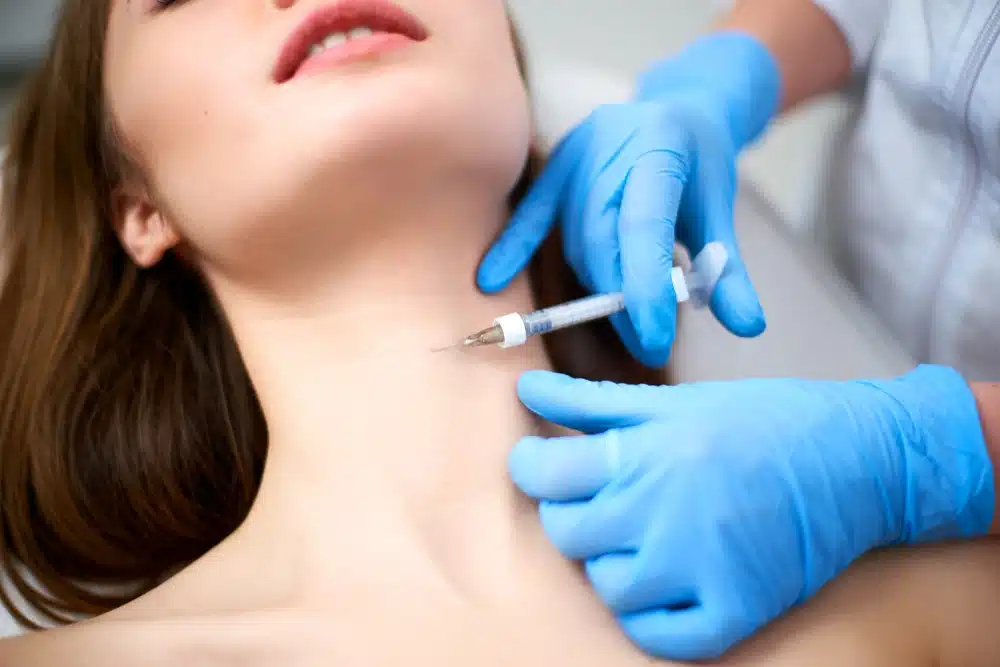
Botox for platysmal bands relaxes the vertical neck cords that pull the jawline down, and it has been FDA-approved for this exact use since October 18, 2024. Those cords are the front edges of the platysma, a thin sheet of muscle that runs from the collarbone up over the jaw. When it tightens, it works against the jawline instead of with it. Treating it is a different job from treating a wrinkle, and the dosing, the technique and the honest expectations all change. Here is what the treatment does, how many units the label calls for, what the trial data actually showed, and who it suits.
Updated October 5, 2026 by the Esthetica Medspa clinical team.
The essentials
- Botox Cosmetic holds FDA approval for moderate to severe platysma bands, granted October 18, 2024. This is an on-label use, not an off-label one.
- The approved doses are 26, 31 or 36 units, placed along the jawline and down the vertical neck bands, depending on how many bands are treated.
- In the approval trials, 65% and 62% of treated patients were satisfied or very satisfied at day 14, against 12% on placebo.
- It softens muscle pull on the jawline. It does not tighten loose skin or remove fat, so it is not a substitute for a neck lift.
- All seven Esthetica Medspa locations treat the platysma as part of an injectables consultation, and candidacy is assessed in person.
What are platysmal bands?
Platysmal bands are the vertical cords that appear on the front of the neck when the platysma muscle contracts. The platysma is a broad, flat muscle covering the front of the neck; its medial edges thicken and become visible with age and with repeated activity, which is why the bands often show most when you talk, swallow or clench. On the label the condition is written as “platysma bands,” and in the clinic you may hear either term.
Two things make bands look worse over time. The muscle itself becomes more active and more defined, and the skin over it loses the thickness that used to hide it. That matters for treatment choice: a neuromodulator addresses the first cause and does nothing about the second.
Is Botox for platysmal bands FDA-approved?
Yes. On October 18, 2024 the FDA approved Botox Cosmetic for the temporary improvement in the appearance of moderate to severe platysma bands associated with platysma muscle activity. It joined three earlier cosmetic approvals for the same product, which is useful context when you are comparing claims between providers.
| Botox Cosmetic indication | Common name | FDA approval date |
|---|---|---|
| Glabellar lines | Frown lines, 11 lines | April 12, 2002 |
| Lateral canthal lines | Crow’s feet | September 11, 2013 |
| Forehead lines | Horizontal forehead wrinkles | October 3, 2017 |
| Platysma bands | Vertical neck bands | October 18, 2024 |
Source: Botox Cosmetic FDA approval history and the AbbVie announcement of the platysma bands approval, both read October 5, 2026. Approval applies to Botox Cosmetic specifically, and not to every neuromodulator on the market.
How many units of Botox do platysmal bands need?
The label specifies three total doses: 26 units, 31 units or 36 units. Which one you get depends on how many bands are being treated and whether your bands are symmetrical. The injections are split between the jawline and the bands themselves, using smaller aliquots than a frown line treatment.
In label terms, jawline points receive 2 units each across four sites per side, and each neck band receives 1 unit at each of five points along its length. One band per side comes to 26 units. An asymmetric pattern, with two bands on one side and one on the other, comes to 31 units. Two bands per side comes to 36 units.
| Pattern treated | Total units (FDA label) | Where it goes |
|---|---|---|
| One band each side | 26 units | 4 jawline points per side at 2 units, plus 5 points per band at 1 unit |
| Two bands one side, one the other | 31 units | Same jawline pattern, three bands mapped |
| Two bands each side | 36 units | Same jawline pattern, four bands mapped |
Source: Botox Cosmetic dosage guide reflecting the FDA prescribing information, read October 5, 2026.
For comparison, glabellar lines take 20 units in total and crow’s feet take 24 units. The neck is a larger map with more, smaller placements rather than a few deep ones. If you want the full picture across the face, our guide to Botox units by area sets the zones side by side.
What results did the approval trials show?
Two placebo-controlled studies supported the approval, and both met their primary endpoints with p values below 0.0001 on investigator and patient assessments. The satisfaction numbers are the most readable part: at day 14, 65% of treated patients in one study and 62% in the other said they were satisfied or very satisfied, against 12% in each placebo group.
The stricter measure is worth knowing too, because it sets expectations honestly. A two-grade or greater improvement on the assessment scale was reached by 32% of treated patients in the first study (63 people) and 31% in the second (64 people), against 2% and 0% on placebo. In plain terms: most people notice a visible softening, and a minority get a dramatic change. Results vary, and your starting anatomy is the main reason why.
How is a platysma treatment different from a Nefertiti lift?
A Nefertiti lift is a technique, while platysmal bands are a finding. The Nefertiti approach places product along the jawline and upper platysma specifically to reduce downward pull and sharpen the jaw contour; treating visible vertical bands focuses on the cords themselves. In practice the two overlap, and many treatment plans do both in one visit because the label dosing already includes jawline points.
The distinction matters when you book. If your concern is a blurred jawline, read our explanation of the Nefertiti lift and what a Botox neck lift can and cannot do. If your concern is the cords you can see when you talk, this page is the right starting point. Your injector will map what is actually moving before deciding.
Who is a good candidate, and who is not?
The best candidates have bands that are clearly driven by muscle activity: they get more obvious when you animate, clench or lift your chin, and they soften when the muscle is at rest. Skin quality is still reasonable, and the jawline is blurred by pull rather than by heaviness.
It is a weaker fit when the dominant problem is loose skin, submental fat or bone-level change. A neuromodulator will not tighten a lax neck, and treating an already lax neck aggressively can make it look softer rather than sharper. We would rather tell you that at the consultation than treat and disappoint you. People who are pregnant or breastfeeding, who have a neuromuscular disorder, or who have had a reaction to a botulinum toxin product should not be treated.
What should you expect on the day and afterwards?
The appointment itself is short. Mapping the bands takes longer than the injections, because your injector needs to see the muscle move. Expect a visit of roughly 20 to 30 minutes including assessment, with no anesthesia required for most people and tiny needles throughout.
Aftercare is the same as for facial Botox: stay upright for about four hours, skip strenuous exercise, saunas and facials for 24 hours, and do not rub or massage the treated area. Onset is gradual, with most people noticing change within 3 to 7 days and the full effect settling by around two weeks, which is when the trials measured their results. Our Botox aftercare guide covers the first 48 hours in detail.
Neck treatments carry their own risks because the muscles involved help with swallowing and head position. Reported effects can include neck pain, difficulty swallowing and temporary weakness. These are uncommon and usually mild, and they are the reason this area belongs with an injector who treats it regularly rather than with whoever has an opening.
How long does it last?
Plan on a repeat at roughly three to four months, in line with other Botox treatment areas, with individual variation in both directions. Duration tends to be shorter when the muscle is strong and very active, which is common in the platysma. Our guide to how long Botox lasts and what shortens it explains the factors you can influence and the ones you cannot.
Where can you have this done at Esthetica?
Platysma treatment is handled through an injectables consultation at any of our seven locations, including Esthetica Medspa Tampa. Across all seven, Botox for forehead lines, frown lines and crow’s feet are listed as named services, and neck and jawline work is assessed case by case, because candidacy here depends far more on your anatomy than on a menu. Our injectors will tell you if your neck is a skin problem rather than a muscle problem, and what the realistic alternatives are. You can review the full treatment overview on our Botox service page.
Frequently asked questions
Does Botox for platysmal bands tighten loose neck skin?
No. It reduces muscle pull on the jawline and softens the visible cords, but it does not tighten skin or remove fat. If laxity is your main concern, a skin-tightening or surgical option is the honest conversation to have.
How many units will I need for my neck?
The FDA label allows 26, 31 or 36 units depending on how many bands are treated and whether they are symmetrical. Your injector maps your bands in person before confirming the dose.
Is a neck Botox treatment painful?
Most people describe it as a series of quick pinches. The needles are very fine and no anesthesia is typically needed, though topical numbing can be used if you are anxious about it.
When will I see results, and how long do they last?
Most people notice softening in 3 to 7 days, with the full effect around two weeks. Expect to repeat at roughly three to four months. Results vary from person to person.
Can I combine platysma treatment with masseter Botox?
Often, yes, and the two are frequently discussed together because both affect the lower face contour. Our page on masseter Botox for jaw slimming explains that treatment, and your injector will sequence them if both apply to you.
Is this the same as a liquid neck lift?
No. “Liquid neck lift” is a marketing phrase that can mean several different treatments. Botox for platysma bands is a specific, FDA-approved use with a defined dose range, which is the standard worth asking any provider to meet.
Sources
- AbbVie: Botox Cosmetic receives FDA approval for moderate to severe platysma bands, October 18, 2024.
- Botox Cosmetic dosage guide, reflecting FDA prescribing information, read October 5, 2026.
- Botox Cosmetic FDA approval history, read October 5, 2026.
This article is general information, not medical advice. Treatment suitability is assessed in person by a licensed provider. Individual results vary.