
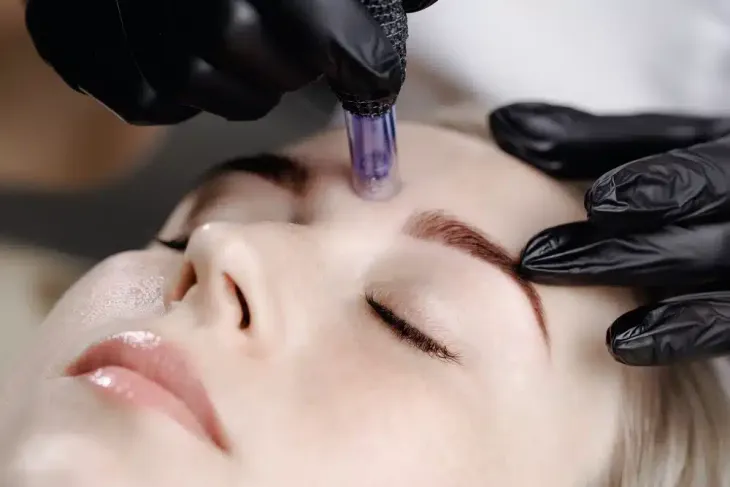
Microneedling near Cincinnati is a collagen-induction treatment that uses very fine needles to prompt your skin to rebuild itself over the following weeks. Patients across the Cincinnati area come to us for it because it addresses the things a facial cannot reach: acne scarring, enlarged pores, fine lines and uneven texture. We treat the Cincinnati market from our Bellevue, KY location, a few minutes across the river, and this guide covers what the treatment involves, how many sessions you should plan for, and who it genuinely suits.
The essentials
- Microneedling creates controlled micro-injuries in the skin, which triggers the body’s own wound-healing and collagen production.
- It is a series, not a single appointment. Most plans involve multiple sessions spaced several weeks apart.
- Results build gradually over months as new collagen forms, rather than appearing immediately after a session.
- Downtime is short. Most patients look flushed for a day or two, similar to mild sunburn.
- It suits most skin tones, which is one of its practical advantages over some laser treatments.
What is microneedling and how does it work?
Microneedling is a procedure that uses a device with fine, sterile needles to make hundreds of tiny punctures in the upper layers of the skin. Each one is small enough to close quickly on its own, but together they register as an injury your body needs to repair. That repair response is the entire point: it prompts the skin to produce new collagen and elastin, the two proteins that give skin its firmness and bounce and that we steadily lose from our twenties onward.
Because the mechanism is your own healing response rather than something applied to the surface, results appear on the skin’s timetable, not on yours. The American Academy of Dermatology notes that microneedling works by prompting the body to make more collagen, and that patients need to be patient with the timeline for that reason (American Academy of Dermatology).
The treatment is sometimes called collagen induction therapy, which is a more descriptive name for what is actually happening. If you want the full national guide to the treatment before reading about our Cincinnati-area service specifically, we cover it in what is microneedling.
What does microneedling treat?
Microneedling is most useful for concerns rooted in skin texture and scarring rather than in muscle movement or volume. The strongest evidence and the most consistent patient satisfaction sit with acne scarring, which is where the treatment earned its reputation. Rolling and boxcar acne scars respond well because the collagen rebuild fills them in from underneath over successive sessions.
Beyond scarring, patients come to us for enlarged-looking pores, fine lines, general dullness and uneven texture, and stretch marks on the body. Some patients also see improvement in pigmentation, though pigment concerns often respond better to a different treatment or to microneedling combined with the right topical program.
| Concern | How well microneedling suits it | What to expect |
|---|---|---|
| Acne scarring (rolling, boxcar) | Strong fit | Gradual softening over a series, results build for months |
| Fine lines and texture | Strong fit | Smoother surface and improved tone across the series |
| Enlarged-looking pores | Good fit | Pores appear refined as surrounding collagen firms |
| Stretch marks | Moderate fit | Often needs more sessions than facial treatment |
| Deep wrinkles or loose skin | Poor fit | A tightening or resurfacing treatment suits better |
| Active, inflamed acne | Not appropriate | Treat the active acne first, then address scarring |
That last row matters. Treating over active, inflamed breakouts risks spreading bacteria and worsening the situation, so we settle active acne before starting a scar-focused series. This is the kind of assessment that is worth an in-person appointment rather than an online booking form.
How many microneedling sessions will you need?
Most patients need a series rather than a single session, and the number depends on what you are treating. Texture and fine lines generally need fewer sessions than established acne scarring, which is the most demanding of the common indications. Your provider sets the plan after examining your skin, and it is normal to reassess partway through once we can see how you are responding.
Sessions are spaced several weeks apart, which is not an arbitrary interval. Collagen remodeling takes weeks to complete, so treating again too soon means stacking injury on skin that has not finished the repair from the previous session. The gap is doing real work even though nothing visible is happening.
The American Society of Plastic Surgeons notes that microneedling results appear gradually and that a course of treatments is typical rather than exceptional (American Society of Plastic Surgeons). We plan the series with you at consultation and quote the full course, not just the first appointment, so you know the commitment before you start.
Once the initial series is complete, many patients move to occasional maintenance sessions spread across the year. That is optional. Skin continues to age after a course finishes, so maintenance is about holding ground rather than fixing something that went wrong.
What is the downtime after microneedling?
Expect your skin to look flushed and feel tight immediately after, similar to a mild sunburn. That redness typically fades substantially within 24 to 48 hours, though it can last a little longer with more aggressive treatment settings. Some patients notice mild flaking or dryness in the days that follow as the surface turns over.
The aftercare is straightforward but not optional. Keep the skin clean and leave it alone, skip makeup for the first day, avoid active ingredients such as retinoids and acids until your provider clears them, and skip the gym, saunas and hot tubs while the micro-channels are closing. Sun protection is the one that matters most: freshly treated skin is more vulnerable to pigment changes, so daily broad-spectrum sunscreen is non-negotiable during a series.
Most patients schedule treatment when they have a quiet couple of days rather than the night before an event. If you have something important coming up, tell us at booking and we will time the series around it.
Who is a good candidate for microneedling?
Good candidates are adults in general good health with texture, scarring or fine-line concerns, realistic expectations about a gradual timeline, and the willingness to complete a series rather than judging the treatment after one appointment.
One of microneedling’s practical strengths is that it is generally suitable across a wide range of skin tones. Treatments that work by heat or light carry a higher risk of pigment changes in deeper skin tones, whereas microneedling works mechanically. That said, the risk is not zero, and an experienced provider adjusts depth and aftercare accordingly.
It is not suitable for everyone. We do not treat over active acne, open wounds, active cold sores or infected skin. Patients with a history of keloid scarring need a careful conversation first, since the treatment relies on a healing response. Certain medications and skin conditions, and pregnancy, are also reasons to wait or choose something else. Bring your full medication list to the consultation.
The realistic limits are worth stating plainly. Microneedling improves scars, it does not erase them. It refines texture, it does not lift sagging skin. If you come in wanting the result of a surgical procedure without surgery, we will tell you that honestly rather than sell you a series that cannot deliver it.
Why Cincinnati patients come to our Bellevue location
Our Bellevue, KY location sits at 119 Fairfield Ave, Suite 6, Bellevue, KY 41073, which is a short drive from downtown Cincinnati, Newport and Covington. For anyone in the Cincinnati area, it is often a quicker trip than crossing town.
The practical advantage of coming to us is that microneedling sits alongside the rest of our treatment range at this location, so if your consultation concludes that a different approach fits your concern better, or that microneedling works best combined with something else, we can plan that in the same place rather than sending you elsewhere. Chemical peels, injectables and laser hair removal are all offered here.
Esthetica Medspa is women-led with seven US locations, and every plan is made in person by a licensed provider. You can see the full treatment list, hours and directions on our Bellevue location page, or read the wider overview of what we offer in our guide to the med spa in Bellevue, KY. Full details of the treatment itself are on our microneedling service page.
Frequently asked questions
How much does microneedling cost in the Cincinnati area?
Pricing depends on the area treated and the number of sessions in your plan, and most patients are quoted for a series rather than a single appointment. We give you the full cost of the recommended course at your consultation, so you can weigh the whole commitment rather than just the first session.
How many microneedling sessions do I need for acne scars?
Acne scarring generally needs more sessions than texture or fine lines, and the exact number depends on scar type and depth. Your provider sets the plan after examining your skin and reassesses partway through. Results continue to build for months after the final session.
Does microneedling hurt?
A topical numbing cream is applied before treatment, and most patients describe the sensation as pressure and vibration with some prickling, particularly over bony areas like the forehead. It is generally well tolerated. Tell your provider if you are uncomfortable, since settings can be adjusted.
How long does it take to see results from microneedling?
Skin often looks brighter within a week, but the meaningful change comes from new collagen, which forms over weeks and months. Most patients judge the result several months after starting rather than after the first session. Results vary from person to person.
Is microneedling safe for darker skin tones?
Microneedling is generally considered suitable across a wide range of skin tones because it works mechanically rather than with heat or light, which lowers the risk of pigment changes compared with some laser treatments. Risk is not eliminated, so provider experience and diligent sun protection still matter.
Can I combine microneedling with other treatments?
Often yes, and for some concerns a combination works better than either treatment alone. The sequencing and spacing matter, though, so this is planned at consultation rather than booked ad hoc. We will tell you if combining would mean compromising either result.


