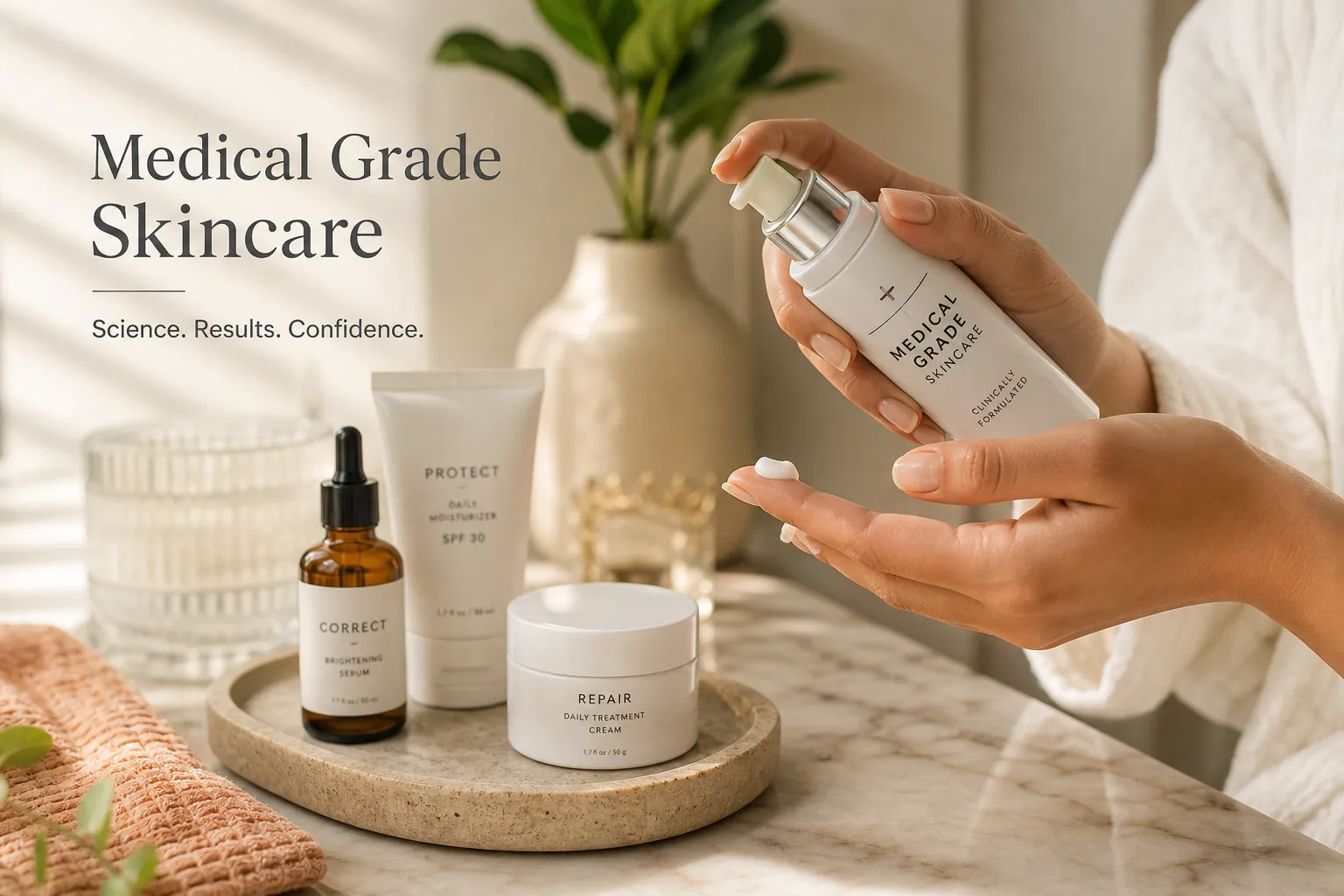
The phrase “medical grade skincare” shows up everywhere now: department store end caps, Instagram ads, email subject lines from brands you’ve never heard of. But if you ask most people what the term actually means, you get a blank stare. That’s not surprising, because the phrase has been stretched so far that it’s nearly meaningless on its face. At Esthetica Medspa, clients bring up this exact question during nearly every skincare consultation. The confusion is completely understandable given how liberally the label gets used.
This guide cuts through the noise. You’ll learn what actually separates professional-grade formulations from what’s on drugstore shelves, which ingredients have real clinical evidence behind them, how to start high-potency actives without wrecking your skin barrier, and how to figure out where to buy these products. No filler. Just the information you need to make a smarter decision about your skin.
What the “medical grade” label actually means (and what it doesn’t)
“Medical grade skincare” is not an FDA-defined regulatory category. The Federal Food, Drug, and Cosmetic Act classifies products as cosmetics, OTC drugs, or prescription drugs based on their intended use and active ingredients, not on where they’re sold or who endorses them. A product sold through a dermatology office can still be legally classified as a cosmetic. The label alone gives you zero information about what’s actually in the bottle.
That said, the absence of a legal definition does not mean all skincare is created equal. The practical differences that do exist live in the formulation itself. Products sold through professional channels, sometimes called cosmeceuticals or physician-dispensed skincare, tend to use higher concentrations of proven actives, undergo more rigorous clinical testing, and prioritize formula stability in ways that mass-market brands don’t. The distinction is real. You just won’t find it on the packaging or in the marketing copy.
The most useful filter when evaluating any professional skincare claim is this: look for published clinical data tied to a specific named product, check the concentration of the active ingredients, and verify that the formula is designed to keep those actives stable until they reach your skin. If a brand can’t point to any of those things, the “medical grade” label is doing a lot of heavy lifting on a thin foundation.
How medical grade skincare formulations work
The formulation gap between clinical-strength and mass-market skincare is most obvious with vitamin C. Leading professional lines use 15 to 20 percent L-ascorbic acid in pH-optimized formulas designed around the narrow window where the ingredient is both effective and stable, typically a pH below 3.5 with additional stabilizers like vitamin E and ferulic acid. Most drugstore options either sit below 10 percent, use more stable but less directly active derivatives like sodium ascorbyl phosphate, or compromise on packaging in ways that accelerate oxidation before the product even reaches your skin.
Oxidation is the key issue here. L-ascorbic acid is inherently unstable. When it’s exposed to light, air, or heat and oxidizes before it makes contact with your skin, you’re applying an inactive ingredient, one that can actually produce free radicals that stress the skin rather than protect it. The stability of a formula determines whether the active does anything at all. This is why clinical-grade products invest in airless packaging, opaque bottles, and precise pH calibration rather than aesthetically pleasing dropper tops.
Retinoids follow the same logic. Clinical formulations use tested delivery systems designed to reduce the surface irritation that causes people to abandon retinoid use entirely, while maintaining the depth of penetration needed for meaningful collagen stimulation. The result is a product that’s more likely to be tolerated long enough to actually work.
On the clinical evidence side, the gap is just as meaningful. SkinCeuticals C E Ferulic is cited in more than 100 peer-reviewed studies. SkinMedica’s TNS Advanced+ Serum has data from a 24-week double-blind clinical study showing measurable improvements in fine lines, texture, sagging, and hyperpigmentation, with some outcomes visible at two weeks. That’s the benchmark for what real clinical evidence looks like in this category. A vague “clinically tested” claim on the back of a $30 serum is not the same thing.
Results by skin concern: what the evidence actually shows
Aging
For anti-aging, the most evidence-backed actives are retinoids, vitamin C at therapeutic concentrations, peptides, and daily SPF. Retinoids remain the gold standard for stimulating collagen and accelerating cell turnover. Vitamin C at 15 to 20 percent L-ascorbic acid addresses oxidative stress and uneven tone. Sun exposure is the primary driver of visible aging, and no amount of serum offsets skipping SPF, it’s non-negotiable. Clinical-strength anti-aging serums generally run from $80 to $250 depending on the active and formulation tier, and both the SkinMedica TNS line and SkinCeuticals antioxidant serums have published outcome data to support their price points.
Hyperpigmentation
For hyperpigmentation, the dermatologist-recommended hierarchy is straightforward. Prescription 4% hydroquinone is the strongest available brightening agent. Obagi’s Nu-Derm System uses hydroquinone as a core component and showed 92 percent improvement in melasma across 200 participants in a 6-month clinical trial. Below prescription strength, tranexamic acid at 2 to 5 percent and high-dose vitamin C are the most evidence-backed OTC options. The concentration of the active is what drives the result, not the brand name.
Acne
For acne, the clinical hierarchy centers on retinoids, benzoyl peroxide, and azelaic acid. Tretinoin at 0.025 to 0.1 percent is prescription-only and the most studied option. Adapalene at 0.1 percent is available OTC and has solid evidence behind it. Benzoyl peroxide at 2.5 to 10 percent addresses the bacterial component. Azelaic acid at 10 to 20 percent handles both bacteria and post-inflammatory pigmentation, making it especially useful for acne-prone skin that also deals with dark spots after breakouts.
Rosacea
Rosacea is where prescription actives earn their place most clearly. Metronidazole at 0.75 to 1 percent, ivermectin at 1 percent, and azelaic acid at 15 to 20 percent all have clinical data for redness reduction and inflammatory papule management. These aren’t ingredients you can approximate with a soothing OTC moisturizer. For rosacea management, a licensed prescriber is typically part of the equation.
What to know before starting high-potency actives
The most common mistake people make with clinical-strength skincare is starting too aggressively. A new prescription retinoid applied every night from day one almost guarantees peeling, tightness, and eventual abandonment of a product that would have worked beautifully with a slower introduction. The standard approach is to begin with the lowest effective concentration, use it two to three nights per week for the first few weeks, and increase frequency only once your skin is consistently tolerating it without irritation.
For tretinoin specifically, a common titration schedule looks like this:
- Weeks 1 to 2: 0.025% every third night
- Weeks 3 to 4: every other night if tolerating well
- Weeks 5 to 6: five nights per week with only mild or no irritation
- Weeks 7 to 8: nightly use if peeling and redness have largely resolved
The adjustment period is typically two to four weeks. Dryness, mild peeling, and some initial redness are normal during that window. Persistent stinging, raw skin, or tightness that doesn’t resolve are signs to pull back frequency, not push through.
Ingredient stacking is where even experienced skincare users run into trouble. Combining prescription retinoids with high-concentration glycolic acid on the same night significantly increases the risk of barrier disruption. Applying benzoyl peroxide and a retinoid at the same time can degrade both actives and irritate skin simultaneously. Hydroquinone works best in 3-month cycles with breaks rather than as an indefinite daily routine. These aren’t permanent rules, but they’re the starting-point guardrails that keep high-potency products from causing more harm than good in the early weeks of use.
Where to access these products and how to start the right way
Most medical grade skin care products do not require a prescription and are available through authorized brand websites or select retailers. Products containing tretinoin, tazarotene, or 4% hydroquinone do require a licensed prescriber, and those must come through a clinic or telehealth provider. Some professional brands like SkinMedica distribute primarily through licensed medical providers and authorized clinical settings, a distribution choice by the brand, not a legal requirement.
The practical difference between buying a clinical-grade product online and getting it through a medspa or dermatology practice is the guidance that comes with it. When you pick up a serum through an online retailer, you have a product. When you start with a consultation, you have a protocol: the right product for your specific skin concerns, in the right sequence relative to your other routine steps, with adjustments made based on how your skin actually responds.
At Esthetica Medspa, clients who want to incorporate medical grade skincare get access to the SkinMedica line alongside a personalized protocol built around their skin concerns and any in-office treatments they’re receiving, whether that’s laser, microneedling, or a chemical peel. This matters because the best clinical-strength serum can underperform or cause unnecessary irritation when it’s layered incorrectly around active treatments. Knowing what to use, when to use it, and what to skip is what turns a good product into a visible result.
With more than 18 years of experience and over 500,000 treatments completed, the team at Esthetica has seen every combination of skincare routine and in-office treatment imaginable. Complimentary consultations are available for exactly this reason: to match the right medical-grade skincare products to your actual skin goals rather than leaving you to figure out the protocol alone.
The bottom line on medical grade skincare
Medical grade skincare is a real category with real formulation advantages. The products that actually deliver are the ones with published clinical data, therapeutic-level ingredient concentrations, and stable delivery systems. The label is not the guarantee; the formulation is. Most people are well-served by a short list of targeted, well-formulated actives used consistently, rather than a cabinet full of products with impressive-sounding but unverified claims.
If you’re not sure where to start, a complimentary consultation at Esthetica Medspa is the most direct way to identify which medical grade skincare products fit your skin concerns, your current routine, and any in-office treatments you’re considering. Rather than buying three serums and hoping for the best, you leave with a focused protocol and the confidence that your investment is actually working toward a real outcome.
Book your medical grade skincare consultation at Esthetica Medspa or ask about our SkinMedica product line during your next visit. Your skin goals deserve a protocol that’s built around them, your consultation is the starting point.