
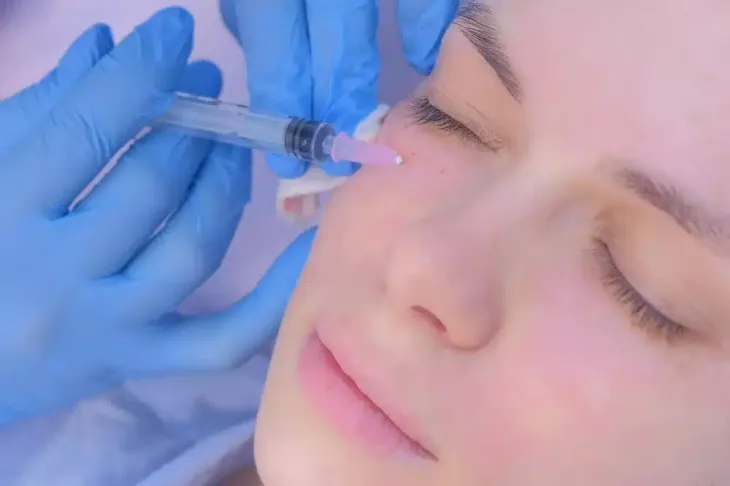
Under eye filler is a hyaluronic acid gel placed in the hollow between the lower eyelid and the cheek to soften the shadow that reads as a dark circle. It works well for one specific cause of tired-looking eyes, volume loss, and it does very little for the others. Knowing which one you have is the whole decision, and it is the part most people skip.
The essentials
- Under eye filler treats hollowing, also called the tear trough or infraorbital hollow. It does not treat pigment, loose skin or puffiness from fat prolapse.
- Two products carry an FDA approval for this exact area: JUVÉDERM VOLBELLA XC, approved February 2022, and Restylane Eyelight, approved June 2023.
- Volumes are small. This is the area where restraint separates a rested look from a puffy one.
- Hyaluronic acid fillers can be dissolved with hyaluronidase, which is a genuine safety advantage in the periorbital area.
- Reported duration ranges from about one year to eighteen months depending on the product. Results vary between patients.
- The risks in this area are not theoretical. Injector anatomy knowledge matters more here than anywhere else on the face.
On this page
- What under eye filler treats, and what it does not
- Which products are FDA approved for this area
- Are you a good candidate?
- What the appointment involves
- Results, timeline and how long it lasts
- Risks, side effects and reversal
- What drives the cost
- When something else is the better answer
What does under eye filler actually treat?
The under eye area darkens for several different reasons and they look similar in the mirror while responding to completely different treatments. Filler addresses exactly one of them.
The first cause is volume loss. Fat pads under the eye descend and shrink, the bone of the orbital rim remodels with age, and the result is a groove running from the inner corner of the eye down and outward. Light falls into that groove and casts a shadow. On camera and under overhead lighting it reads as a dark circle even when the skin itself has normal pigment. This is what filler corrects, by levelling the transition between lid and cheek so the shadow has nowhere to sit.
The second cause is pigment. Some people, particularly those with richer skin tones or a family history of it, have genuinely darker skin under the eye from melanin rather than shadow. Adding volume beneath pigmented skin does not lighten it, and can make it more visible by bringing it forward. Pigment needs pigment treatments.
The third is skin laxity and fine crepe texture, where the skin has thinned and lost elasticity. Filler placed under lax skin has a habit of showing itself, either as visible lumps or as a bluish tint called the Tyndall effect, caused by light scattering through superficial gel. The fourth is true fat prolapse, where the fat pad bulges forward and creates a bag. Filler placed below a bulge can improve the transition, but a significant bag is a surgical problem.
If you want to work through this decision by cause across every available option rather than filler alone, our detailed comparison of under eye wrinkle treatments, fillers versus lasers versus creams is the companion piece to this one. This guide covers the filler procedure itself in depth. That one covers how to choose between modalities.
Which fillers are FDA approved for under eye hollows?
FDA approval is granted for a named product in a named area, based on clinical study data for that specific use. Two products currently carry an approval for the infraorbital area in the United States.
JUVÉDERM VOLBELLA XC received FDA approval in February 2022 for the improvement of infraorbital hollows in adults over the age of 21 (AbbVie). Restylane Eyelight followed in June 2023, approved for the correction of under eye hollows and formulated with Galderma’s NASHA technology, which produces a firmer gel that resists water absorption, with results reported up to eighteen months (Galderma).
| Product | Approved use | Approval date | Reported duration | Reversible |
|---|---|---|---|---|
| JUVÉDERM VOLBELLA XC | Improvement of infraorbital hollows, adults over 21 | February 2022 | Up to 1 year | Yes, with hyaluronidase |
| Restylane Eyelight | Correction of under eye hollows | June 2023 | Up to 18 months | Yes, with hyaluronidase |
You will hear about other products being used under the eye. Some clinicians use lightweight hyaluronic acid fillers approved for other facial areas, which is an off-label decision a licensed clinician is permitted to make. It is a fair question to ask any provider directly: which product are you using here, and is it approved for this area? The FDA maintains a public list of approved dermal fillers if you want to check.
Are you a good candidate for under eye filler?
The best candidates have mild to moderate hollowing, reasonable skin thickness and elasticity under the eye, no significant fat prolapse, and realistic expectations about what a shadow correction looks like. Good general health and no active infection in the area are baseline requirements.
Candidacy weakens as skin thins. Very lax or crepey under eye skin makes visible product and the Tyndall effect more likely. Significant puffiness that is worse in the morning may be fluid retention or fat prolapse rather than hollowing, and filler can accentuate a bulge instead of correcting it. Chronic allergic shadowing, thyroid eye conditions and some medications produce under eye changes that filler will not touch.
Filler is not appropriate during pregnancy or breastfeeding, since it has not been studied in those groups, nor over active skin infection, nor where there is a known allergy to a product component. Blood thinners and supplements such as fish oil and high-dose vitamin E increase bruising in an area that bruises readily. Bring your full list to consultation.
One more thing worth saying plainly: a good injector will sometimes tell you no. If your under eye concern is mainly pigment, or if your skin is too thin to hold product well, the right answer is a different treatment or none at all. Our guide on finding a qualified medspa injector sets out the questions that separate a careful assessment from a sales conversation.
What happens during an under eye filler appointment?
The consultation comes first and it should include looking at your face in different lighting and asking you to look up and down, since hollowing changes with gaze. Photographs at rest are standard. This is also where the cause of your particular under eye appearance gets identified, which determines everything that follows.
If you proceed, the skin is cleansed and a topical numbing cream is applied for around twenty minutes. Product is then placed deep, close to the bone, in small aliquots, usually with a blunt cannula rather than a sharp needle. The cannula matters here: it pushes vessels aside rather than piercing them, which lowers the risk of intravascular injection in an area rich in blood supply that connects to the eye.
Volumes are deliberately small, typically a fraction of a syringe per side. Injecting conservatively and reviewing in two weeks is the standard approach, because under-correcting is easy to fix and over-correcting under the eye is conspicuous. The injection portion usually takes fifteen to twenty minutes. Most patients go straight back to their day, with the caveat that visible bruising is common enough that you should not schedule this two days before an event.
What results should you expect, and how long do they last?
You will see a change immediately, because hyaluronic acid fills on placement. You should not judge it immediately. Swelling in the first three to five days makes the area look fuller than the settled result, and small lumps often smooth out on their own during that window. The honest review point is two weeks, which is when most clinicians schedule a follow-up and add a small amount more if needed.
The realistic outcome is a softening of the shadow and a less tired appearance, not the elimination of every under eye characteristic. If pigment contributes to your darkness, some of it will still be visible after the hollow is corrected. Patients who understand this in advance are consistently happier with the same clinical result.
Duration depends on product and individual metabolism. Reported figures are up to a year for VOLBELLA XC and up to eighteen months for Restylane Eyelight. The under eye area moves relatively little compared with the lips, which is one reason product tends to last well here. Results vary between patients, and top-ups are usually smaller than the original treatment.
Risks, side effects and how reversal works
Expected side effects are bruising, swelling, tenderness and occasional small lumps in the first days. The under eye bruises more than most areas because the skin is thin and vascular. Arnica and cold compresses are commonly suggested, and time does the rest.
Area-specific complications worth knowing about include the Tyndall effect, a bluish discolouration when product sits too superficially, persistent puffiness if too much product is placed or if it attracts water, product migration, and lumps that need dissolving. All of these are correctable, which is precisely why hyaluronic acid is preferred here over permanent materials.
The serious risk is the one the FDA highlights for all fillers: unintentional injection into a blood vessel. The agency states that while the chance is low, the resulting complications can be serious and may be permanent, including tissue necrosis, vision abnormalities including blindness, and stroke (FDA, Dermal Fillers). The periorbital region deserves particular respect because of its vascular connections to the eye. The FDA also advises working with a licensed healthcare professional experienced in injecting fillers, never buying filler online, and never using needle-free injection devices.
Reversal is straightforward for hyaluronic acid products. Hyaluronidase, an enzyme that breaks down hyaluronic acid, is injected into the area and typically resolves the product within a day or two. Ask any provider whether they keep it on site before you let them inject near your eye. There is only one acceptable answer.
What drives the cost of under eye filler?
Filler is quoted per syringe, and under eye treatment usually uses less product than most other areas, often a single syringe split between both sides. What moves the total is the product chosen, whether a follow-up top-up is included, and whether the plan addresses the midface as well, since restoring cheek support sometimes reduces how much under eye product is needed at all.
Be sceptical of a price quoted before anyone has looked at your face. We quote after assessment for the same reason we photograph first: the plan determines the number, not the other way round. For context on demand rather than price, Google Ads data for the United States records about 27,100 monthly searches for under eye filler and 8,100 for tear trough filler, with under eye filler cost at roughly 3,600 (DataForSEO, August 2026). Cost is clearly on people’s minds, which is why we prefer to answer it in person and accurately.
When is something other than filler the right answer?
If pigment is the dominant cause, treatments that target melanin are the appropriate route, and adding volume will not lighten anything. If the issue is fine crepe texture with good underlying volume, collagen-stimulating treatments and a properly built topical routine are better placed. If skin laxity dominates, energy-based tightening or, at the significant end, surgical eyelid procedures are the realistic options.
Often the correct answer is a combination in sequence: restore structural volume first, let it settle, then treat skin quality on top. Neither approach substitutes for the other. Our area-by-area guide to the best dermal fillers for your face covers how the under eye fits into a whole-face plan, and our dermal fillers service page lists what we offer.
Esthetica Medspa provides JUVÉDERM treatments and dermal fillers across our locations. Whether under eye filler specifically is right for you is a decision we make with you at consultation, after assessing the actual cause of what is bothering you. You can browse our full range on the injectables page or book a consultation to talk it through.
Frequently asked questions
How long does under eye filler last?
Reported duration is up to one year for JUVÉDERM VOLBELLA XC and up to eighteen months for Restylane Eyelight. Individual metabolism, the volume placed and the product used all affect the answer, and results vary between patients.
Does under eye filler get rid of dark circles?
It improves dark circles caused by shadowing from hollowness, which is the most common cause. It does not lighten dark circles caused by pigment in the skin itself, and it will not help puffiness caused by fat prolapse. Identifying which cause you have is the point of the consultation.
Is under eye filler painful?
Most patients describe pressure rather than pain. Topical numbing cream is applied beforehand and many products contain lidocaine. Treatment with a blunt cannula tends to be more comfortable than with a needle, and the whole injection portion usually takes under twenty minutes.
How long does the swelling and bruising last?
Swelling generally settles within three to five days and bruising can last up to a week to ten days in this area, since the skin is thin and vascular. Judge the final result at two weeks rather than the day after.
Can under eye filler be dissolved?
Yes. Hyaluronic acid fillers are dissolved with hyaluronidase, usually within a day or two of injection. This reversibility is one of the main reasons hyaluronic acid products are preferred for the under eye area over permanent materials.
What is the difference between under eye filler and tear trough filler?
They describe the same treatment. The tear trough is the anatomical name for the groove running from the inner corner of the eye toward the cheek, and infraorbital hollow is the clinical term used in FDA approvals. Patients search for under eye filler, clinicians write tear trough.


