
Choosing the right under eye wrinkle treatment starts with one question: is the problem volume loss, skin laxity, or surface crepe lines? The skin beneath your eyes is markedly thinner than most facial skin, which is why it shows every structural change aging brings. It’s often the first place clients notice a shift and, unfortunately, one of the most common places they end up spending money on the wrong solution. Choosing a retinoid eye cream when the problem is volume loss, or rushing into filler when surface crepe lines dominate, produces frustrating results and may delay appropriate corrective treatment while prolonging patient frustration.
Here’s the core issue: under-eye wrinkles don’t all share the same cause. What looks like “tired eyes” to one person may be tear trough hollowing, loose skin texture, fine surface lines, or all three at once. The clinicians at Esthetica Medspa see this distinction clearly every day, because a significant portion of new clients arrive having already tried the wrong solution elsewhere. This guide walks through every major option, from over-the-counter retinoids to Juvederm fillers and fractional CO2 lasers, so you can match treatment to cause rather than guess.
What actually causes under-eye wrinkles (your treatment depends on this)
Volume loss vs. laxity vs. surface crepe: three different problems
Under-eye aging falls into three distinct categories, and they look different enough that you can begin to self-assess before you ever sit in a treatment chair. The first is hollowing from volume loss, commonly called tear trough deformity, which creates a shadowed, sunken appearance and contributes significantly to the look of dark circles. The second is skin laxity, where the skin loses elasticity and folds loosely under expression or hangs slightly below the orbital rim. The third is surface crepe lines, the fine, tissue-paper texture lines that appear directly on the skin surface from collagen breakdown.
Many adults past midlife are dealing with some combination of all three, but one category usually dominates. Identifying that dominant cause is the single most important step before selecting any under eye wrinkle treatment, because the tools that fix hollowing do almost nothing for surface texture, and the tools that improve skin quality cannot replace lost volume.
How aging changes the periorbital area
The structural changes underneath the skin drive everything visible on the surface. Fat pads around the eye descend with age, the underlying bone of the orbital rim resorbs and widens, the orbicularis oculi muscle weakens, and collagen production in the thin skin below the eye slows significantly. Sun exposure accelerates surface damage by degrading collagen and elastin fibers, while genetics influence how much volume loss occurs and at what pace.
Understanding this helps set realistic expectations. A deeply hollowed tear trough is a structural, anatomical issue. No topical ingredient penetrates deep enough to reverse bone resorption or restore a fat pad. Fine surface lines driven by UV exposure and collagen loss, on the other hand, respond meaningfully to the right topical regimen combined with consistent sun protection.
Topical treatments: the foundation your skin actually needs
What retinoids can (and can’t) do for under-eye skin
Retinoids are the most evidence-backed topical category for periorbital fine lines. A 12-week randomized controlled trial showed a 33% improvement in periorbital wrinkles using a retinoid-based eye cream, and studies on tretinoin 0.05% applied nightly demonstrate measurable wrinkle depth reduction within 12 weeks, with further gains continuing through six months. The mechanism is well understood: retinoids stimulate collagen production, thicken the epidermis, and accelerate cell turnover, all of which improve fine surface lines over time.
The under-eye area requires lower concentrations than the rest of the face because the skin is thinner and more reactive. Tretinoin at 0.025% is the typical starting point for periorbital use, with 0.05% reserved for those who have built tolerance. For over-the-counter retinol products, concentrations in the commonly used range of approximately 0.2% to 1.0% in a cream or lotion formulation are appropriate. The key limitation is clear: retinoids address surface crepe lines effectively, but they cannot restore lost volume or meaningfully tighten significantly lax skin. If hollowing or sagging is your primary concern, retinoids are a supporting player, not the lead.
Peptides, eye creams, and SPF: supporting roles
In a 12-week study, a peptide-rich AM eye cream used alongside a PM retinoid regimen produced a 64% reduction in puffiness and improved skin texture. Hyaluronic acid-based formulations reduce dryness and can temporarily plump fine lines by drawing moisture to the surface, but they provide no structural correction. These products are genuinely useful tools for early-stage surface lines and for maintaining results after in-office treatments.
SPF is non-negotiable, every single day, regardless of what else you are doing. UV exposure remains the single largest driver of surface wrinkle formation, and skipping daily broad-spectrum sun protection while spending money on eye creams is counterproductive. Set realistic expectations here: topicals work well for mild surface lines, but once volume loss or laxity is the dominant issue, consistent product use will not produce the same result as a well-executed in-office treatment.
Under eye wrinkle treatment with dermal fillers: when topicals aren’t enough
How Juvederm and HA fillers restore under-eye volume
Hyaluronic acid fillers are the most evidence-backed non-surgical option for tear trough hollowing. Juvederm Volbella XC received FDA approval specifically for infraorbital hollows, with clinical trial data showing an 83.1% responder rate at three months and 90% patient satisfaction at one year. Results have been documented to persist beyond 18 months in published retrospective chart reviews, which makes the cost-per-year calculation more favorable than many patients initially assume.
The technique involves placing small volumes, typically 0.2 to 0.5ml per side, along the tear trough to level the lid-cheek junction and eliminate the shadowing that creates the appearance of dark circles and hollowness. One of the most important advantages of HA fillers is reversibility: hyaluronidase dissolves the product quickly if a patient is unhappy with the result or experiences a complication. At Esthetica Medspa, the team brings extensive experience performing Juvederm under-eye and mid-face treatments, and the consistent lesson is that anatomical precision separates a natural, refreshed result from an overdone one. Volume placement in the periorbital area requires detailed knowledge of the infraorbital anatomy, and clinical outcomes correlate strongly with injector experience and anatomical knowledge.
Who is the right candidate for under-eye fillers
Fillers work best for patients with mild to moderate hollowing and good baseline skin tone. Placing filler into thin, hyper-lax skin increases the risk of visible lumps, the Tyndall effect (a bluish tint caused by superficial filler placement), and product migration. The typical side effect profile is mild: bruising and swelling for one to three days, which resolves on its own. In 2026, the realistic cost range for both eyes is $800 to $2,000 total, depending on provider, location, and volume needed.
A thorough injector assessment before treatment is not optional. Self-diagnosing tear trough hollowing without ruling out fat prolapse, skin laxity, or pigmentation as the primary cause leads to suboptimal results and sometimes complications. Booking a complimentary consultation with an experienced clinician before committing to any filler treatment is always the smarter first step. For more information on potential complications, review the five key risks of under-eye filler injections.
Laser and energy-based treatments: resurfacing at the structural level
What fractional CO2 laser does for under-eye skin
Ablative fractional CO2 laser is the strongest non-surgical tool for surface crepe lines and mild skin laxity. It works by resurfacing the epidermis in a controlled pattern and triggering significant collagen remodeling in the dermis, producing results that continue improving for months after the procedure. Patients can expect five to ten days of redness, crusting, and peeling during recovery, with results lasting one to five years per session depending on individual skin behavior and sun exposure habits.
Cost ranges from $800 to $4,000 depending on session depth, geographic location, and provider expertise. Darker skin types carry a higher risk of post-inflammatory hyperpigmentation from ablative laser, which is why provider selection and pre-treatment assessment are particularly important for Fitzpatrick types III and above. At Esthetica Medspa, the clinical approach often combines Juvederm for structural volume correction with fractional CO2 laser for surface texture refinement. The filler restores the architecture underneath; the laser improves the quality of the skin on top. Neither modality accomplishes both goals independently, but together they address the full picture of periorbital aging.
Microneedling and RF microneedling: the middle-ground options
Microneedling is the lower-downtime alternative for collagen stimulation, with one to three days of redness and a cost of $300 to $800 per session. Three to six sessions are typically recommended for cumulative texture improvement, making it a good fit for patients who want progressive results without extended downtime. Radiofrequency microneedling, such as Morpheus8, adds a skin-tightening component to collagen induction by delivering controlled heat energy into the dermis, making it useful for mild skin laxity as well as texture concerns.
Compared directly to CO2 laser, microneedling carries lower risk for darker skin types and requires significantly less recovery time, but the results are less dramatic and less durable. For patients whose primary concern is mild surface texture without significant volume loss or laxity, RF microneedling at $600 to $1,500 per session represents a practical middle ground between topical-only care and full laser resurfacing.
Choosing an under eye wrinkle treatment: matching the right option to your anatomy
If hollowing and dark shadows are your dominant complaint, HA fillers are the first-line non-surgical treatment. If volume loss is significant and you want a more permanent correction, fat grafting or surgical repositioning becomes relevant. Fillers alone do not address skin laxity, so patients dealing with both hollowing and loose skin often benefit from combining fillers with a resurfacing treatment once volume is restored and the filler has fully settled, typically two to four weeks post-injection.
For patients whose main concern is loose skin texture or fine crepe lines, a retinoid-plus-laser protocol is the most evidence-based approach. Mild laxity responds well to RF microneedling or fractional laser. Significant skin laxity, where excess skin folds under the eye, may ultimately require lower blepharoplasty ($4,000 to $8,000), which addresses excess skin and repositions fat structurally in a way no non-surgical option can replicate. Surface crepe lines that have not responded to six or more months of consistent retinoid use will see the most meaningful improvement from fractional laser or microneedling paired with an ongoing topical routine.
What to expect: costs, downtime, and realistic timelines
| Treatment | Downtime | Result Duration | Cost Range |
|---|---|---|---|
| Under-eye fillers | 0, 2 days | 6, 18 months | $800, $2,000 (both eyes) |
| Fractional CO2 laser | 5, 10 days | 1, 5 years | $800, $4,000 per session |
| Standard microneedling | 1, 3 days | 6, 12 months (cumulative) | $300, $800 per session |
| RF microneedling | 2, 5 days | 6, 18 months | $600, $1,500 per session |
| Surgical blepharoplasty | 7, 14 days | 5, 10+ years | $4,000, $8,000 |
When you calculate cost per year of result rather than cost per treatment, fillers and fractional laser often become more economically rational than patients initially assume. A single CO2 laser session at $2,000 producing three years of improvement works out to roughly $55 per month, which compares favorably to accumulating retinol eye creams and supplements that never address the underlying structural issue.
The clearest signal that it’s time to stop the DIY approach: if six months of consistent retinoid use has produced no visible improvement, the concern is structural, not superficial. If hollowing or persistent dark circles are present regardless of sleep quality or hydration, volume loss is the likely cause and no topical will correct it. A complimentary consultation with a trained clinician is the most efficient next step, because treatment decisions based on self-diagnosis are where most clients waste significant time and money.
The protocol that actually works: pairing treatment to cause
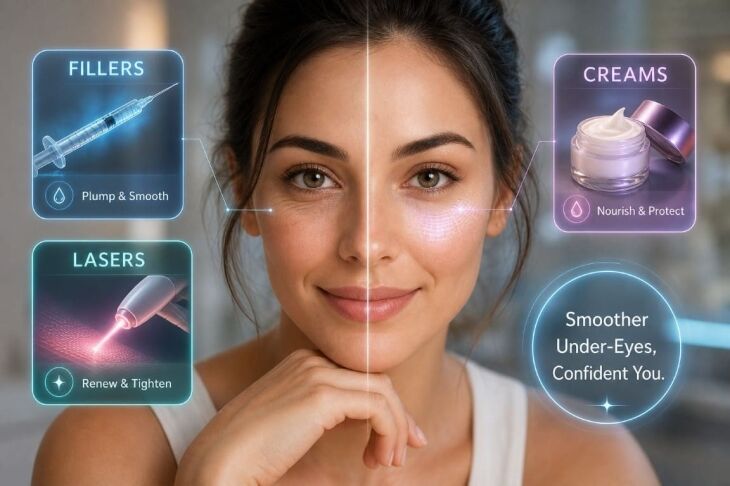
Effective under eye wrinkle treatment is about matching the right tool to the right problem. Topicals slow surface damage and maintain early-stage fine lines. Fillers rebuild the structural volume responsible for hollowing and shadowing. Lasers and microneedling stimulate collagen and refine skin quality. Combination protocols address the full picture for patients navigating both structural and surface changes at the same time.
Esthetica Medspa’s clinical approach reflects exactly this logic. Pairing Juvederm volume correction with fractional CO2 resurfacing where appropriate, and building individualized retinoid maintenance protocols around each patient’s specific skin type and goals, consistently delivers results that go beyond what any single treatment achieves in isolation. The team of medically trained nurse practitioners assesses your facial anatomy before recommending anything, so the process is built around your biology, not a generic menu.
If you’ve been stacking eye creams with limited results, or you’re weighing whether fillers, laser, or a combination is the right next step, the most practical move is a complimentary consultation. No protocol recommended before anyone has actually assessed your anatomy, just an honest, experienced evaluation of what will work for what you’re dealing with. Book yours at Esthetica Medspa and start with clarity instead of guesswork.


