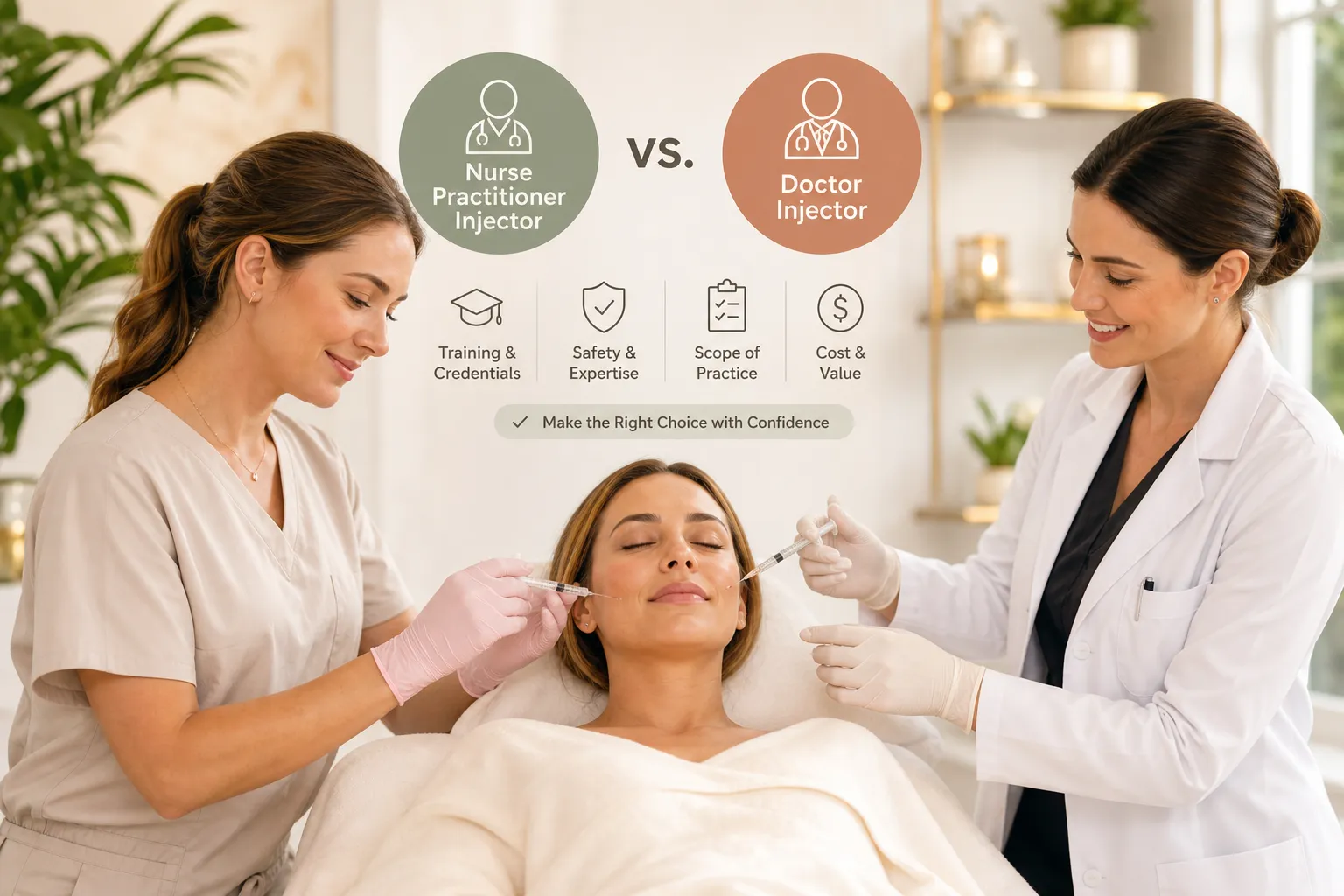
When patients ask whether a nurse practitioner injector vs doctor makes a difference for their Botox or filler results, they’re asking exactly the right question, just not quite in the right way. The credential on the wall tells you far less about your outcome than the training, experience, and clinical environment behind the person holding the needle. What most patients don’t hear until they’ve already booked the wrong appointment is this: provider title is not the primary predictor of a safe, effective result.
At Esthetica Medspa, our nurse practitioners have been delivering injectable treatments for over 18 years, with more than 500,000 completed treatments across our client base. That track record didn’t come from a title. It came from focused training, consistent practice, deep anatomical knowledge, and a medically supervised clinical structure built around patient safety. This article walks you through how NP and physician training actually compare for injectables, what scope-of-practice laws mean in the real world, what the safety data shows, what you should expect to pay, and the exact questions to ask any injector before you book.
Nurse Practitioner Injector vs Doctor: How Training Actually Compares
Physicians complete medical school followed by residency, which gives them the broadest formal foundation in anatomy, pharmacology, and diagnosis. Nurse practitioners complete graduate-level nursing education, national certification, and advanced clinical training, with state-dependent authority to practice independently. Those are real differences, and it’s worth knowing them. The more clinically relevant point, though, is this: neither degree program includes aesthetic injectable training as a core competency.
Both physicians and nurse practitioners complete supplemental procedural courses to learn Botox and filler technique. These courses cover facial anatomy, injection technique, product selection, complication recognition, and hands-on practice on live models. Accredited programs typically include 6 to 8 hours of hands-on work, and a two-day hands-on format with live models is common across programs that welcome both NPs and physicians. Course length ranges from a single-day intensive to multi-week programs, and a certificate of completion confirms coursework only, it does not grant legal authority to inject. That authority comes from licensure and state law.
Why Volume and Repetition Matter More Than Baseline Credentials
The practical implication is straightforward. An NP injector with five years of focused aesthetic experience and regular continuing education can outperform a physician who completed one weekend course five years ago. Aesthetic medicine is a skill that deepens with volume and repetition. Baseline education matters, but it’s the starting point, not the finish line. When evaluating a nurse practitioner injector vs doctor injector, what separates excellent results from poor ones is almost always accumulated case volume and ongoing training, not the degree itself.
Scope of Practice and Supervision: What the Rules Mean for Your Treatment
States fall into three categories for nurse practitioners: full practice, reduced practice, and restricted practice. In full-practice states, NPs evaluate, diagnose, treat, and prescribe under their own licensure with no physician oversight required. More than half of U.S. states currently fall into this category, including Arizona, Colorado, Florida, Nevada, Oregon, and Washington. In reduced and restricted states, NPs require a collaborative agreement or physician supervision for some or all practice activities. The American Association of Nurse Practitioners (AANP) maintains a current state-by-state practice environment map for patients who want to verify their state’s classification. You can also review state-specific certification rules for injectables on a state-by-state resource about Botox certification by state.
What this means practically is that in many states, a licensed NP at a properly structured medspa operates with the same legal authority to administer Botox and dermal fillers as a physician in the same setting. Physician supervision, where required, does not mean a physician watches every injection. It typically means a supervising or collaborating physician is on record, protocols are in place, and the practice carries appropriate liability coverage. Professional organizations have summarized typical supervisory models and clinic expectations in documents such as midlevel injectable practice patterns in dermatology and plastic surgery offices. What actually protects you is the clinic’s medical director structure, written safety protocols, and emergency management procedures, not the injector’s specific degree.
Before any appointment, ask whether the practice has a supervising physician or medical director on record, what their credentials are, and what the emergency protocol looks like. A well-run practice answers those questions immediately and with confidence. One that hesitates is a red flag regardless of whether the injector is an NP or an MD.
Nurse Practitioner Injector vs Doctor: What the Safety Data Shows
No robust, injectable-specific study currently demonstrates higher complication rates for NPs versus physicians in routine aesthetic practice. That’s not spin, no large-scale comparative dataset specific to aesthetic injectables currently exists to support a clear title-based conclusion. Complications from Botox and dermal fillers are relatively uncommon, adverse-event reporting is not mandated at the federal level, and clean comparative datasets don’t yet exist. Based on available adverse-event reporting and published complication reviews, provider title is not the primary predictor of outcomes.
Key Predictors of Safe Injection Results
What actually predicts a safe injection result comes down to a specific set of factors: cumulative case volume, thorough patient assessment, honest disclosure of the provider’s limitations, and a clear referral protocol for complex cases. Knowledge of vascular anatomy is non-negotiable, particularly the ability to recognize and respond to vascular occlusion.
Vascular occlusion is a rare but serious complication where filler blocks arterial blood flow. Managing it requires hyaluronidase on hand, a written vascular occlusion protocol, and a clear escalation path to emergency ophthalmic care when visual symptoms are present. Any medspa injector vs clinic physician comparison should include this question: does your provider have hyaluronidase stocked, and do they have a documented protocol for using it?
A credentialed, experienced NP injector is statistically more comparable to a credentialed, experienced physician injector than either is to an inexperienced provider of any title. That framing shifts the question from “which degree is safer?” to “which provider in front of me has the training, volume, and protocols to handle whatever comes up?”
What Botox and Fillers Typically Cost, and Why NP-Led Medspas Are Priced Differently
Botox in U.S. markets ranges from roughly $11 to $25 or more per unit, with full treatment areas typically landing between $300 and $600. Dermal fillers commonly run $600 to $1,000 or more per syringe depending on the product, market, and clinic tier. Physician-only practices, particularly in dermatology or plastic surgery settings, tend to charge at the higher end of those ranges. That premium reflects overhead, professional billing structure, and market positioning, not necessarily better outcomes.
NP-led medspas operating under medical director oversight carry lower overhead than private physician practices, which is why the same FDA-approved products and the same evidence-based techniques are available at a more accessible price point. This is a business model difference, not a quality difference. Cost should absolutely factor into your decision, but it should never be the only factor. Weigh price against credentials, demonstrated experience, and the quality of the consultation process every time. For a consumer-facing breakdown of pricing differences and what to expect, see this guide to Botox vs fillers: uses, side effects, cost differences.
How to Vet Any Injector Before You Book
These questions apply whether you’re evaluating a nurse practitioner injector vs doctor injector, a PA injector vs MD injector, or any other licensed aesthetic provider. Ask them before you commit.
- What is your active state license, and are there any restrictions on your practice?
- What formal injectable training have you completed, including facial anatomy coursework, hands-on hours, and complication management protocols?
- How many neuromodulator and filler cases have you completed, and how long have you been injecting?
- Can I see standardized before-and-after photos of patients with similar anatomy and goals, taken with consistent lighting and angles?
- What is your protocol if a complication like vascular occlusion occurs, and do you have hyaluronidase on site?
- Who is the medical director of this practice, and what are their credentials?
The red flags are equally important to recognize. Walk away from any provider who can’t or won’t answer questions about their training or licensing. Walk away from practices that show only heavily filtered images or have no before-and-after documentation at all. A provider who promises dramatic results, dismisses the possibility of side effects, or offers no formal consultation process before treatment is not a safe choice regardless of their credentials. Unusually low pricing with no explanation is worth questioning as well, it often signals cut-rate products, undertrained staff, or both.
For more in-depth advice on choosing and evaluating clinics, see our Medspa Tips & Guides | Esthetica Medspa.
Why Esthetica Medspa’s NP Injectors Set the Standard
Esthetica Medspa’s nurse practitioners bring graduate-level medical training, continuous aesthetic education, and a combined track record built across 18-plus years and more than 500,000 completed treatments. Every injectable appointment begins with a thorough consultation, pre-treatment photography, and a personalized protocol built around your specific facial anatomy and aesthetic goals. That’s not a marketing line, it’s the clinical standard that has kept clients returning for years and referring the people they care about.
The practice operates under full medical oversight with a licensed medical director, documented safety protocols, and emergency management procedures in place. Because Esthetica operates as a medspa rather than a physician-only specialty clinic, clients receive the same rigorous standard of care at a price point that makes ongoing aesthetic maintenance realistic. Learn more about the distinction between facility types in our Medical Spa vs Aesthetic Clinic: Key Differences. Complimentary consultations and flexible payment plans remove the pressure from the decision-making process so you can focus on finding the right plan for your goals.
The Bottom Line on Choosing Your Injector
The nurse practitioner injector vs doctor debate matters less than most people assume going into it. What genuinely matters is proper licensure, demonstrated case volume, thorough technique training, complication management knowledge, and a supervised clinical environment. Both NPs and physicians can deliver exceptional injectable results, and both can fall short if the training and experience aren’t there to back them up.
Use the vetting checklist in this article, ask the hard questions during your consultation, and choose your provider based on credentials and documented outcomes rather than the letters after their name. The injector who takes time to understand your anatomy, explains the risks honestly, photographs your baseline, and has a clear plan for complications is the right injector. When deciding between a nurse practitioner injector vs doctor, prioritize training, case volume, and clinic protocols over title alone, every time.
If you’re ready to experience what that standard looks like in practice, book a complimentary consultation at Esthetica Medspa and let our team build a personalized injectable plan around your goals.