
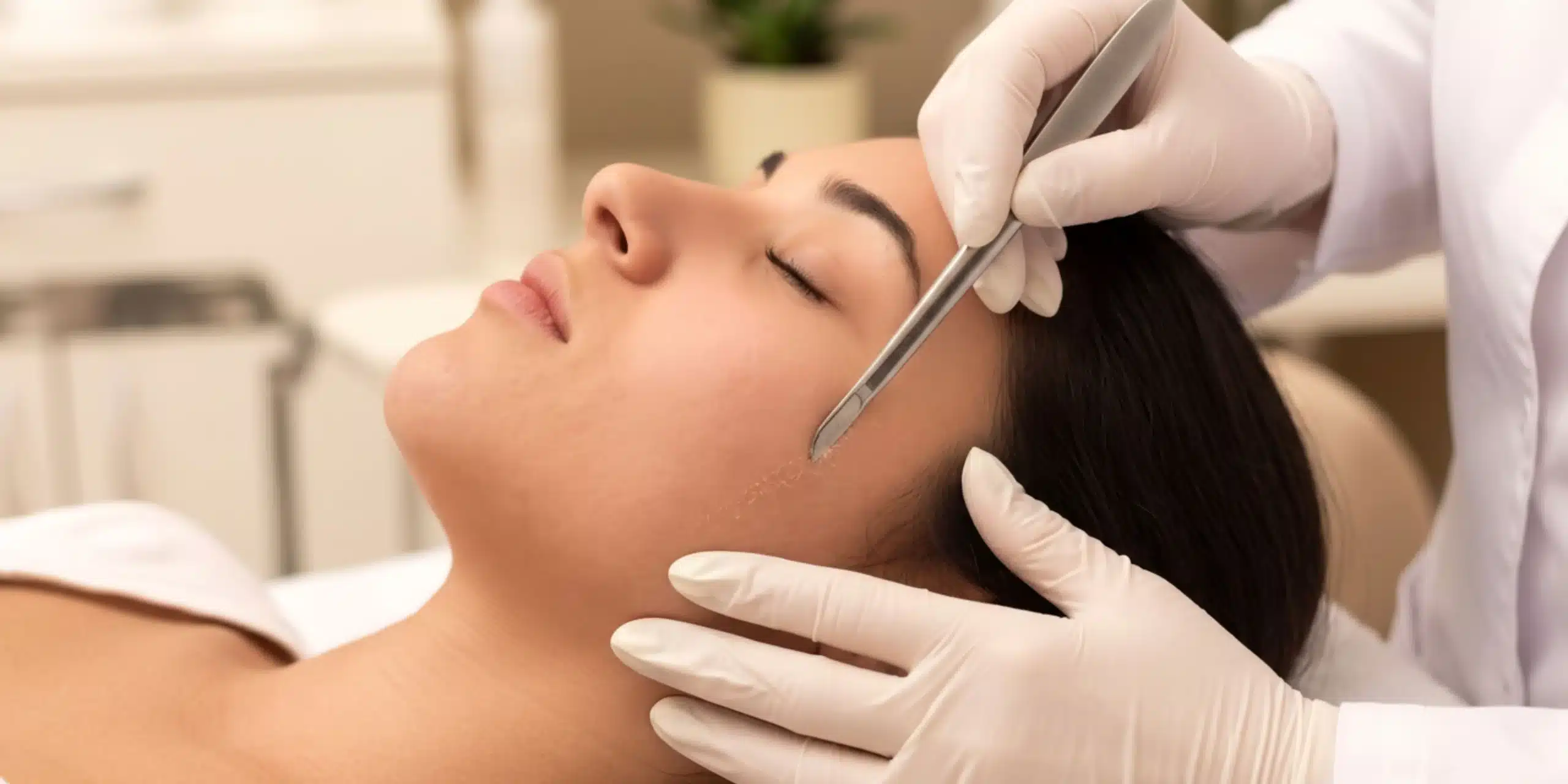
Dermaplaning is a manual exfoliation treatment in which a sterile blade is drawn across the skin at a shallow angle to remove dead surface cells and fine vellus hair, the soft down often called peach fuzz. It takes about thirty minutes, needs no downtime and leaves skin noticeably smoother. Whether it is the right treatment for you depends less on the hype and more on your skin type, and that is where most guides stop being useful.
The essentials
- Dermaplaning removes dead surface skin and vellus hair with a blade. It is physical exfoliation, not a laser and not a chemical.
- Skin looks smoother immediately and makeup sits better. Effects are surface level and temporary, roughly three to four weeks.
- It does not make hair grow back thicker or darker. That is a myth, and dermatologists have been correcting it for decades.
- It is a poor fit for active acne, inflamed breakouts, rosacea flares and eczema on the treatment area.
- Sun protection afterwards is not optional. Freshly exfoliated skin burns more easily.
- Esthetica Medspa does not currently offer dermaplaning. We do offer other professional exfoliation options, covered below, so you can compare honestly.
On this page
- What dermaplaning is and how it works
- Does the hair grow back thicker?
- What a session actually involves
- What results to expect and how long they last
- Who it suits and who should skip it
- Dermaplaning compared with other exfoliation treatments
- Aftercare that protects the result
- What we offer instead
What is dermaplaning and how does it work?
Dermaplaning uses a sterile surgical blade held at roughly a forty five degree angle and drawn across taut skin in short strokes. Two things come off in the process: the layer of dead keratinised cells sitting on the surface of the stratum corneum, and the vellus hair that grows across the cheeks, jaw and upper lip. Nothing is injected, nothing is heated and no chemical is applied.
The immediate effect is optical as much as tactile. Dead cells scatter light unevenly, and a fine layer of vellus hair does the same. Take both away and skin reflects light more uniformly, which reads as brightness. That is why the after photos look dramatic and why the effect fades: skin turns over continuously and the surface layer rebuilds within weeks.
The secondary benefit is one many patients care about more. With the dead layer removed, serums and moisturisers meet less resistance, so a good skincare routine tends to perform better for a few weeks after treatment. This is also the reason dermaplaning is often paired with another treatment rather than done alone.
It is worth being clear about what dermaplaning is not. It does not stimulate collagen in any meaningful way, so it does not treat wrinkles at a structural level. It does not reach the depth needed to change acne scarring or deep pigment. It is a surface treatment that does a surface job well.
Does dermaplaning make hair grow back thicker or darker?
No. This is the single most common worry about the treatment and it is not supported by the evidence. Cutting hair at the skin surface does not affect the follicle, and the follicle is what determines thickness, colour and growth rate. The American Academy of Dermatology explains the mechanism plainly in its guidance on hair removal: shaving cuts hairs at the surface of the skin so you cannot see them, and nothing about that changes what grows beneath (AAD, how to shave).
What does change is how the regrowth feels. A hair that grows in naturally has a fine, tapered tip. A hair cut with a blade has a blunt end, and a blunt end feels coarser against your fingertips even though the shaft is exactly the same diameter as before. That sensation is the whole basis of the myth.
If your goal is to reduce facial hair permanently rather than remove it temporarily, dermaplaning is the wrong tool entirely and no amount of it will help. The AAD sets out the range of options and their trade-offs in its overview of ways to remove unwanted hair, and we compare the clinical options in our guide to hair reduction treatments that actually work. Laser hair removal targets pigment in the follicle and reduces growth over a course of sessions. Dermaplaning targets what is already above the skin, and does nothing below it.
What happens during a dermaplaning session?
The treatment is short and undramatic, which is part of its appeal. Skin is cleansed and dried thoroughly, since the blade needs a dry surface to work cleanly. The practitioner then holds an area of skin taut and works across it in small, controlled strokes, section by section, usually avoiding the eyelids, the nostril margins and any area of broken or inflamed skin.
Most people describe the sensation as a light scraping, closer to a firm brush than to anything painful. No numbing is needed. Including cleansing beforehand and a soothing product and sunscreen afterwards, expect to be in the room around thirty minutes.
The one thing worth insisting on is who is holding the blade. This is a sharp instrument on facial skin, and the difference between a trained practitioner and an untrained one is the difference between exfoliation and a cut. Home devices sold for the same purpose use guarded blades and are a genuinely different product with a genuinely different result. Nicks, irritation and post-inflammatory pigment are the realistic failure modes when the technique is wrong.
What results should you expect, and how long do they last?
You see the effect the moment it is finished. Skin looks brighter, feels smoother and takes makeup more evenly, with foundation sitting flat instead of catching on fine hair. There is no redness for most people, or very mild flushing that settles within an hour, which is why it is often chosen before an event.
Duration is where expectations need managing. Because the treatment works on the outermost layer, and because that layer renews on a cycle of roughly three to four weeks in healthy adult skin, the smoothness fades on the same timeline. Vellus hair regrows over a similar period. Most people who make it part of their routine repeat it about once a month, and there is no cumulative structural benefit to doing it more often than the skin renews.
Set against that, one honest caveat: if what bothers you is fine lines, laxity, acne scarring or melasma, dermaplaning will not move the needle. Those concerns need treatments that work below the surface, and choosing dermaplaning for them means spending money on the wrong thing. Our comparison of DiamondGlow and HydraFacial walks through how to match a facial treatment to a specific concern rather than to a trend.
Who is a good candidate, and who should avoid it?
Dermaplaning suits people with generally healthy skin who want a smoother surface, better makeup application and a short-term brightness lift, particularly those with noticeable vellus hair. It is one of the few professional exfoliation treatments considered reasonable during pregnancy, since nothing is absorbed, though you should always clear any treatment with your own clinician first.
It is a poor choice, and sometimes a harmful one, in several situations. Active inflammatory acne is the clearest: dragging a blade across pustules can spread bacteria and worsen the breakout. Rosacea in flare, active eczema or psoriasis on the face, cold sores, open lesions, sunburn and any recent facial surgery all rule it out for the time being. If you are on isotretinoin or have recently finished a course, wait and ask your prescriber, since the skin is more fragile than it looks.
Two further considerations. If you have a keloid tendency or a history of post-inflammatory hyperpigmentation, any procedure that can nick the skin deserves more caution, and richer skin tones warrant a practitioner experienced across the Fitzpatrick range. And if you use retinoids or acid exfoliants, most practitioners ask you to pause them for several days on either side, because stacking exfoliation is how people end up with a compromised skin barrier.
How does dermaplaning compare with other exfoliation treatments?
Different treatments reach different depths, and depth is what determines what a treatment can actually change. This table compares the mechanism rather than the marketing.
| Treatment | Mechanism | Depth reached | Typical downtime | Best suited to |
|---|---|---|---|---|
| Dermaplaning | Manual blade exfoliation | Surface only | None | Vellus hair, dull surface, makeup prep |
| DiamondGlow | Diamond tip resurfacing plus serum infusion | Surface, with product delivery | None | Dullness, congestion, hydration |
| Chemical peel | Acid solution loosens cell bonds | Superficial to medium, adjustable | None to several days of peeling | Pigment, tone, texture, some acne |
| Microneedling | Controlled micro-injury triggers collagen | Dermis | One to three days of redness | Scarring, fine lines, texture, laxity |
The pattern is straightforward. Dermaplaning gives an immediate cosmetic improvement with zero recovery and zero structural change. Chemical peels and microneedling ask more of you in recovery and give back changes that last, because they work at a level where skin actually rebuilds. Neither category is better in the abstract. They answer different questions.
Aftercare that protects the result
Freshly exfoliated skin has lost its outer buffer, and the single most important consequence is UV sensitivity. Apply a broad-spectrum sunscreen of at least SPF 30 daily afterwards and reapply as directed. Skipping this is how a treatment meant to brighten the skin ends up contributing to pigment.
For the first two to three days, keep the routine gentle. Skip retinoids, exfoliating acids and scrubs, avoid saunas, steam rooms and hot yoga, and use a bland moisturiser to support the barrier. Do not pick at any flaking. After that, resume your usual products, and take advantage of the window in which they absorb more readily.
What we offer instead at Esthetica Medspa
We want to be straightforward here rather than convert an informational search into a booking for something we do not do. Dermaplaning is not currently on our treatment menu. What we do offer across our locations are professional facial treatments that address the same underlying goals of smoother texture, brighter tone and better product absorption: DiamondGlow, chemical peels, microneedling, BroadBand Light and Ultherapy, alongside Diamond Glow at selected sites.
If you came here because your skin looks dull, feels rough or does not hold makeup well, those are treatable concerns and a consultation is the fastest route to knowing which treatment fits. Our team assesses skin before recommending anything, and we would rather tell you that a straightforward routine change would help than sell you a course of something you do not need. You can see the full range on our facial treatments page, or read more about DiamondGlow if surface renewal with serum infusion is what you are after.
Frequently asked questions
How often should you get dermaplaning?
Roughly every four weeks for most people, which matches the natural renewal cycle of the outer skin layer. Doing it more frequently does not deliver extra benefit and increases the risk of irritating the skin barrier.
Is dermaplaning safe?
It is generally considered safe on healthy skin when performed by a trained practitioner using a sterile blade. Risks rise sharply with poor technique or with treatment over active acne, inflamed skin or open lesions. Nicks, irritation and post-inflammatory pigment are the realistic complications.
Can you dermaplane at home?
Home devices exist and use guarded blades, which makes them safer but also less effective than a professional treatment with a surgical blade. If you use one, work on clean dry skin, use light pressure, replace the blade often and never share it.
Does dermaplaning help with acne?
Not with active inflammatory acne, and it can make it worse by spreading bacteria across the face. Skin prone to congestion but currently clear may tolerate it, but acne is better addressed with treatments designed for it. Ask a clinician rather than deciding from a video.
Does dermaplaning hurt?
Most people feel a light scraping sensation and no pain. No numbing agent is used. If it is painful, the pressure or angle is wrong and the treatment should stop.
How popular is dermaplaning?
Search demand in the United States sits at roughly 74,000 queries a month on average for the term dermaplaning, rising to about 90,500 in August, according to Google Ads data pulled in August 2026 (DataForSEO). Interest is substantial and steady, which is exactly why it is worth understanding what the treatment can and cannot do.

