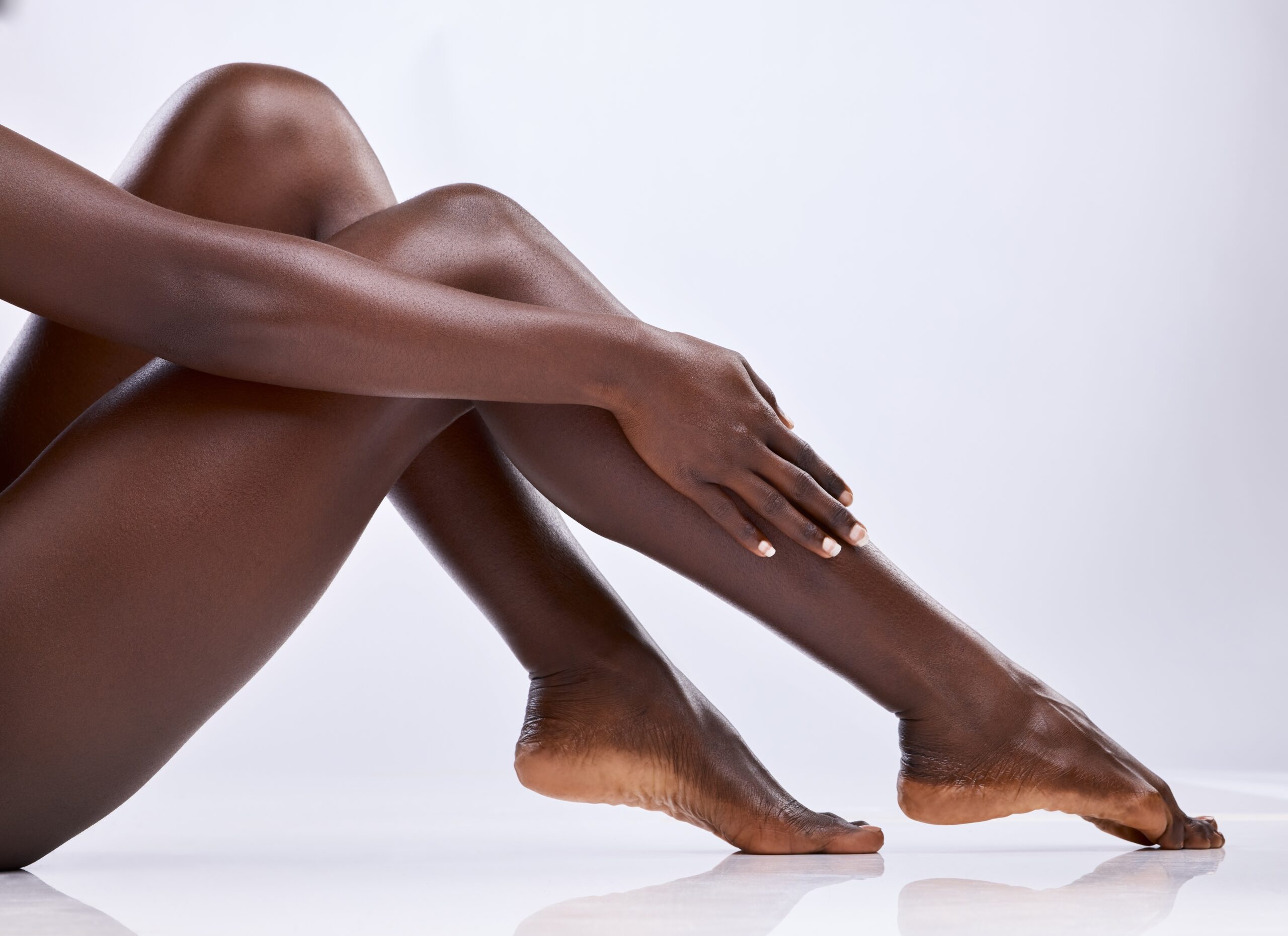
Laser hair removal is safe and effective on darker skin — but only when the right wavelength and protocol are used. If you have Fitzpatrick IV, V or VI skin and you’ve been told “we can’t treat you” or you’ve seen burns and hyperpigmentation from older devices, the issue is not your skin. It is the laser. This guide explains which technologies are safe for melanin-rich skin, how the protocol changes for darker tones, and what realistic results look like across six to eight sessions.
Why laser hair removal is more challenging for darker skin
Lasers remove hair by targeting melanin in the hair follicle and heating it until the follicle stops producing hair. The challenge for darker skin is that melanin is also abundant in the surrounding skin, not only the follicle. If the wrong laser is used, the device can’t tell follicle from skin — it heats both, and the result is burns, blisters and patches of post-inflammatory hyperpigmentation that can take months to fade.
The solution is not to skip laser hair removal. The solution is to choose a wavelength that travels deeper than skin melanin and unloads its energy at the follicle level.
Safe laser technologies for Fitzpatrick IV–VI
Three laser platforms are commonly discussed for darker skin. Their safety profile is not equal.
- Nd:YAG 1064 nm — The gold standard for dark skin. The 1064 nm wavelength penetrates past the epidermis where most skin melanin lives, and targets the hair follicle at depth. It is the only laser type widely considered safe across Fitzpatrick IV, V and VI when used by a trained operator.
- Diode 800–810 nm — Safe for Fitzpatrick I–IV in most settings, and safe for V with experienced operators using conservative parameters and active cooling. It is generally not used on Fitzpatrick VI.
- Alexandrite 755 nm — Excellent results on lighter skin (Fitzpatrick I–III). It is not appropriate for Fitzpatrick IV–VI because the shorter wavelength is heavily absorbed by skin melanin.
- IPL (intense pulsed light) — Not a laser. The broad spectrum is too aggressive on melanin-rich skin and should be avoided for darker tones.
At Esthetica Medspa we use medical-grade Nd:YAG 1064 nm with contact cooling for all Fitzpatrick V and VI treatments, and either Nd:YAG or diode (operator’s choice) for Fitzpatrick IV.
How safety on darker skin has evolved since 2010
Two decades ago laser hair removal on Black skin was widely considered risky. The reason was the dominant technology: short-wavelength devices designed around an idealized lighter-skin patient. Burns and post-inflammatory hyperpigmentation were common enough that many clinics refused Fitzpatrick V and VI patients altogether — not because laser cannot work on darker skin, but because their device could not work on darker skin.
The shift happened in three phases. First, the wider availability of Nd:YAG 1064 nm platforms in medical-grade settings around 2010–2014. Second, the introduction of longer pulse-width protocols and active contact cooling, which dramatically reduced epidermal heating. Third, the publication of clinical protocols specific to skin of color in peer-reviewed dermatology journals, which standardized how trained operators dial in fluence and cooling for each Fitzpatrick type.
Today, on a well-equipped medical spa with a trained team, the risk profile for Fitzpatrick V–VI is comparable to what it has always been for lighter skin — with appropriate protocols. If you were turned away in 2015, the answer in 2026 is almost certainly different.
The Fitzpatrick scale and how we tailor the protocol
The Fitzpatrick scale categorizes skin types I through VI based on how the skin reacts to sun exposure — not by ethnicity. Many patients fit somewhere between two categories. Here is how we adjust parameters:
| Skin type | Laser of choice | Fluence (energy) | Cooling |
|---|---|---|---|
| Type I–II | Alexandrite or diode | Higher | Standard |
| Type III | Alexandrite or diode | Higher-mid | Standard |
| Type IV | Diode or Nd:YAG | Mid | Standard / chilled tip |
| Type V | Nd:YAG 1064 | Mid (longer pulse width) | Active contact cooling |
| Type VI | Nd:YAG 1064 only | Lower-mid (longer pulse width) | Active contact cooling |
The pulse width — how long the laser stays on the skin — matters as much as the wavelength. Longer pulses heat the follicle without overheating the surrounding skin, which is exactly what darker skin needs.
What to expect — sessions, sensation, downtime
A full laser hair removal series for darker skin follows the same six-to-eight session structure as lighter skin, with sessions four to six weeks apart. What is different is the conservative ramp-up: we begin with a test patch, observe healing for 48–72 hours, then proceed with the first full session if everything looks clean.
The sensation is described as a rubber-band snap with warmth. With the chilled tip and longer Nd:YAG pulse, most patients describe it as tolerable. Sessions last 10 minutes for an upper lip, up to 45 minutes for legs.
Downtime is minimal. The treated area may look slightly pink or feel warm for a few hours. By the next day, skin is back to baseline. For our full session-by-session structure, see our how many sessions for face guide.
Common myths about laser hair removal on dark skin
- “Laser can’t be used on Black skin.” False. Nd:YAG 1064 nm is safe and effective on Fitzpatrick VI.
- “You will always get hyperpigmentation.” False. Hyperpigmentation is a risk when the wrong laser is used, not an inevitability with the right one.
- “Results take longer on dark skin.” Partially true. Some patients on Fitzpatrick V–VI need one or two extra sessions because more conservative settings mean less aggressive follicle damage per visit.
- “You can’t treat dark skin in summer.” True for tanned skin of any tone. We schedule treatments before or after periods of sun exposure, with three to four weeks of strict sun avoidance prior to each session.
Patch testing and consultation: how we minimize risk
Before any first treatment on Fitzpatrick IV–VI we run a patch test. We use the same Nd:YAG settings we plan to use for the full session on a small area, then watch for blistering, hyperpigmentation or unusual erythema over 48 to 72 hours. If the test patch is clean, we proceed. If not, we lower the fluence or change the strategy.
The consultation also reviews medications. Some drugs — including certain antibiotics, retinoids and acne medications such as isotretinoin — increase photosensitivity. We always ask, and we always adjust.
Long-term sun protection on treated areas
Sun protection is part of the protocol, not optional. The treated area has temporarily reduced melanin density right after a session, which leaves it more vulnerable to UV damage and to post-inflammatory hyperpigmentation if it gets hit too hard. Our recommendation for Fitzpatrick IV–VI patients during the series and for at least four weeks after each session:
- Daily broad-spectrum SPF 50 mineral sunscreen on exposed treated areas. Mineral (zinc oxide, titanium dioxide) is preferred over chemical for darker skin because it does not absorb into the epidermis.
- Physical cover when possible — long sleeves, hats, sunglasses, swim leggings.
- No self-tanner for three to four weeks before and after each session.
- Avoid hot showers and saunas in the first 48 hours after a session.
- Hydration and bland skincare in the first 72 hours: no retinoids, no exfoliants, no acidic toners on the treated area.
Long term, daily SPF is the single best investment for skin health on any Fitzpatrick type — it prevents the hyperpigmentation patterns that are often blamed on the laser when the real cause was unprotected sun exposure between sessions.
Areas we commonly treat on darker skin
The most common areas we treat with Nd:YAG on Fitzpatrick IV–VI patients:
- Face — Upper lip, chin, sideburns, jawline. Patients with PCOS-driven facial hair often see the biggest impact here.
- Underarms — Quick sessions, high satisfaction, common starter area.
- Bikini / Brazilian — See our Brazilian laser hair removal on deeper skin tones for what the full session looks like.
- Legs — The largest area, treated in two-session zones (upper / lower).
- Back, chest and shoulders — Common for men with darker skin tones.
- Neck — Often treated alongside the face for patients with pseudofolliculitis barbae (razor bumps).
For a broader explainer of how laser hair removal works across skin types, our laser hair removal complete guide covers the full picture.
How razor bumps and laser hair removal interact
Pseudofolliculitis barbae — the medical term for razor bumps — is more common in patients with curly hair shafts and darker skin. Laser hair removal is one of the most effective treatments because it reduces the hair growth that causes the ingrown problem in the first place. We treat the beard, neck, bikini and underarm areas with Nd:YAG on a moderate fluence and most patients see significant reduction by sessions four to five.
Frequently asked questions
Is laser hair removal safe on Black skin?
Yes, when Nd:YAG 1064 nm is used by a trained operator. Alexandrite and IPL are not appropriate. We use Nd:YAG exclusively for Fitzpatrick V and VI.
Will I see results after one session?
You’ll notice shedding hair in the treated area at 10–14 days. Visible thinning is typical by session three. Most patients reach 70–90 percent reduction at six to eight sessions.
How long should I wait between sessions?
Four to six weeks for body, five to seven weeks for face. Hair grows in cycles and we want to catch new follicles in active phase.
Does it hurt more for darker skin?
It can feel slightly warmer because Nd:YAG penetrates deeper. The chilled contact tip and longer pulse width make it tolerable for most patients.
Can I get laser hair removal if I’m tanned?
No. We wait three to four weeks after sun exposure or self-tanner before treating, on any skin type. On darker skin this is non-negotiable.
Will my hair come back?
A small number of follicles may reactivate over time, especially with hormonal changes. Most patients schedule one to two maintenance sessions per year after the initial series.
Is Nd:YAG safe during pregnancy?
We do not perform laser hair removal during pregnancy. There is no clear evidence of harm, but the conservative approach is to wait until after delivery and the post-partum period.
Can vitiligo patients be treated?
Active vitiligo is a contraindication because lasers can trigger spread. We refer patients with active vitiligo to dermatology before any aesthetic treatment.
Book a safe consultation
If you have Fitzpatrick IV, V or VI skin and you have been turned away from laser hair removal elsewhere — or if you have been treated with the wrong device and want to start fresh — our team can walk you through a safe protocol. Book a free consultation at any Esthetica Medspa location, including King of Prussia, Louisville, Tampa and other U.S. locations.