Cheek filler restores volume to the midface, lifting the area under the cheekbone that flattens with age and softening the folds that flattening creates. It is one of the few injectable treatments that changes the shape of the face rather than a single line, which is exactly why it deserves a careful plan rather than a quick appointment.
The essentials
- Cheek filler adds volume to the midface. The visible result is projection and lift, not just fullness.
- JUVÉDERM VOLUMA XC is FDA approved for deep injection for cheek augmentation to correct age-related midface volume deficit in adults over 21, with results reported up to two years.
- Sculptra took a different route and was FDA approved in April 2023 for fine lines and wrinkles in the cheek region, working by stimulating your own collagen over months.
- Treating the cheek often improves the nasolabial fold, because part of that fold is a shadow cast from above.
- The overfilled look comes from placing too much product too superficially, not from cheek filler as a category.
- Results vary between patients, and a consultation comes before any product recommendation.
On this page
- Why the midface loses volume
- What cheek filler actually changes
- Products and FDA approvals
- Hyaluronic acid or collagen stimulator?
- Who it suits
- The appointment, step by step
- How to avoid the overfilled look
- Risks and recovery
- What drives the cost
Why does the midface lose volume?
Midface change is structural, not just superficial, and understanding that explains why creams cannot fix it. Three things happen together. The fat compartments that sit over the cheekbone shrink and descend, so volume that used to sit high moves lower and forward. The bone underneath remodels, the orbital rim widens and the maxilla loses projection, which removes the scaffold the soft tissue was resting on. And the ligaments that hold soft tissue in position gradually loosen.
The visible consequences are familiar even to people who have never named them: flatness beneath the cheekbone, a hollow appearing in the front of the cheek, a deepening line from the nose to the corner of the mouth, and a heaviness along the jaw where descended tissue accumulates. Weight loss accelerates all of it, which is why significant loss can leave the face looking older even when the body looks better.
Genetics set the pace, sun exposure and smoking speed it up, and it usually becomes noticeable somewhere in the late thirties or forties. None of this is pathology. It is anatomy, and it responds to a treatment that addresses volume at the level where the volume was lost.
What does cheek filler actually change?
Placed correctly, cheek filler does two things at once. It restores projection where the cheekbone contour has flattened, which is the change you see directly. And it supports the tissue below it, which is the change you see indirectly, because a supported midface pulls slightly less heavily on the fold running down to the mouth.
That second effect is why patients who arrive asking about their nasolabial folds are often better served by treating the cheek. Filling a deep fold directly can improve it, but if the cause of the fold is a shadow cast by descended tissue above, the fold will keep reappearing until the structure above is addressed. Our guide to nasolabial folds and non-surgical options covers where each approach is the better call.
What cheek filler does not do is tighten skin. If loose skin is the dominant concern, adding volume beneath it can stretch it slightly but will not lift it, and pushing volume until the skin looks tight is precisely how faces end up looking inflated. Laxity is a different problem with different tools.
Which products are used, and what are they approved for?
Two categories are used in the cheek and they behave completely differently.
Hyaluronic acid fillers work immediately by occupying space. JUVÉDERM VOLUMA XC is indicated for deep subcutaneous or supraperiosteal injection for cheek augmentation to correct age-related volume deficit in the midface in adults over the age of 21, with manufacturer data supporting results up to two years (JUVÉDERM, cheek filler). Deep placement is part of the indication, not a stylistic preference. Product placed against or near the bone provides lift; the same product placed superficially provides a lumpy surface.
Collagen stimulators work indirectly. Sculptra, injectable poly-L-lactic acid, received FDA approval in April 2023 for the correction of fine lines and wrinkles in the cheek region, adding to its existing indication for nasolabial fold contour deficiencies. Galderma reported that the product met its primary efficacy endpoint of at least a one-grade improvement in cheek wrinkles at rest, and that 95 percent of patients still showed improved skin glow two years after treatment when injected into the cheek region (Galderma).
| Option | How it works | FDA-approved use cited | Result appears | Reported duration |
|---|---|---|---|---|
| JUVÉDERM VOLUMA XC | Hyaluronic acid, fills on placement | Cheek augmentation, age-related midface volume deficit, adults over 21 | Immediately | Up to 2 years |
| Sculptra | Poly-L-lactic acid, stimulates your own collagen | Fine lines and wrinkles in the cheek region | Gradually, over 2 to 3 months | Up to 2 years |
The FDA publishes a current register of approved dermal fillers and their indications, which is worth checking if a provider recommends a product you have not heard of.
Hyaluronic acid or collagen stimulator: which suits you?
The practical difference is reversibility and timeline. Hyaluronic acid gives you a result the same day and can be dissolved with hyaluronidase if you dislike it or if a complication arises. That combination makes it the sensible starting point for anyone treating the cheek for the first time, because you can see what a volumised midface looks like on your own face before committing to anything longer term.
Collagen stimulators cannot be dissolved. What they offer instead is a change in skin quality alongside volume, built from your own tissue and appearing gradually enough that nobody notices a before and after moment. That gradualness is a genuine advantage for patients who do not want an obvious change, and a genuine drawback for anyone who wants to see the result before deciding whether they like it. Our detailed guide to how Sculptra works, results and cost covers the treatment course, which typically runs across several sessions spaced weeks apart.
Some plans combine both, using hyaluronic acid for immediate structural correction and a collagen stimulator for broader skin quality. That is a decision to make with an injector who has assessed your face, not one to make from a list.
Who is a good candidate for cheek filler?
The clearest candidates have visible midface volume loss with reasonably good skin quality, whether from ageing, significant weight loss or simply a naturally flat midface they would like more definition in. Age matters less than anatomy. A patient in their late twenties with a flat midface and a patient in their fifties with age-related loss can both be appropriate for the same treatment with different plans.
Candidacy is weaker where skin laxity dominates, because filler adds weight to tissue that is already struggling to stay in position. It is weaker again for anyone who has had a lot of product placed previously and is unhappy with the result, where the right first step is often assessment of what is already there rather than adding more.
Filler is not appropriate during pregnancy or breastfeeding, over an active skin infection at the site, or where there is a known allergy to a product component. Bleeding disorders and blood-thinning medication increase bruising risk and need discussing in advance. Autoimmune conditions and a history of granuloma formation warrant a longer conversation before any collagen stimulator.
What happens at a cheek filler appointment?
The consultation drives everything. A good assessment looks at your face from the front and in profile, at rest and smiling, and considers the midface in relation to the jaw, chin and temples rather than in isolation. Photographs are standard. This is also where the treatment plan gets decided, including whether the cheek is really the priority area.
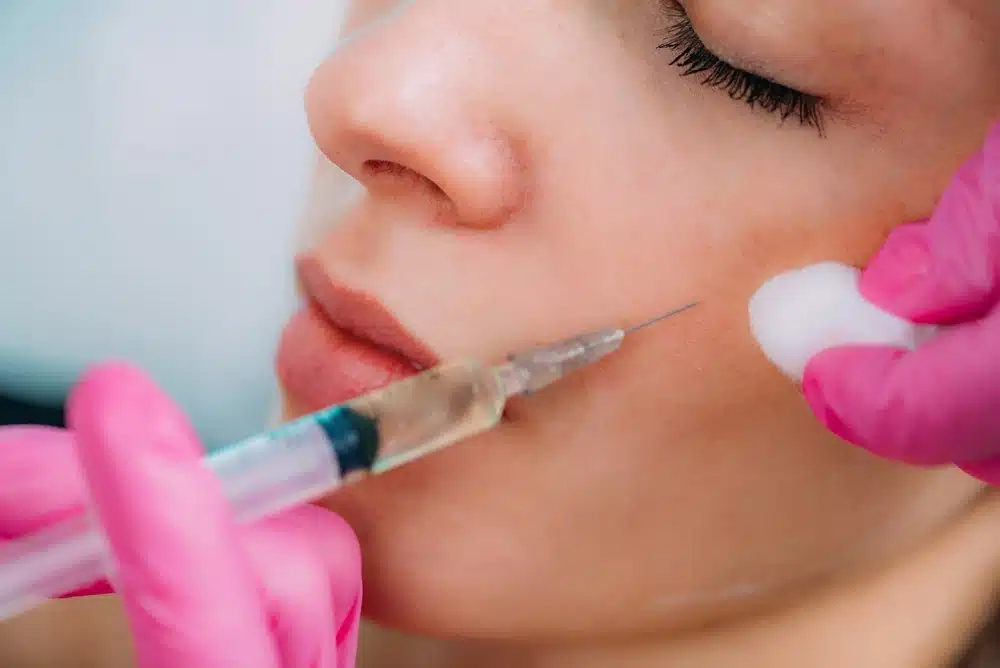
On the day, the skin is cleansed and marked, topical numbing is applied, and product is placed deep, close to the bone, through either a needle or a blunt cannula depending on technique and area. Injection takes roughly twenty to thirty minutes for both sides. Most hyaluronic acid products contain lidocaine, so comfort improves as the treatment progresses.
Afterwards, expect swelling for two to three days and possible bruising for up to a week. Sleep slightly elevated for the first couple of nights, skip strenuous exercise, alcohol and heat for twenty four hours, and avoid facial massage or pressure on the treated area for two weeks. Judge the result at the two week mark, once swelling has resolved and the product has integrated with the tissue.
How do you avoid the overfilled look?
The inflated look that people fear is not a property of cheek filler. It is a property of three specific mistakes, and all three are avoidable.
The first is volume that exceeds what the face structurally lost, usually accumulated across many appointments where each individual top-up seemed small. The second is placement that is too superficial or too far forward, filling the front of the cheek rather than supporting the cheekbone, which produces roundness instead of definition. The third is treating the cheek without reference to the rest of the face, so the midface no longer matches the jaw, chin and temples around it.
The corrective approach is to treat conservatively, review at two weeks, and build across sessions if more is genuinely needed. Photographs at each stage are not vanity, they are the only reliable defence against gradual drift, since the face you see daily is the one you notice change in least. Our piece on facial balancing with fillers covers the whole-face logic behind this in more depth.
Risks and what to watch for
Expected side effects are swelling, bruising, tenderness and temporary firmness at the injection sites, generally settling within a week. Small asymmetries in the first days are common and usually resolve as swelling subsides.
The serious risk applies to all dermal fillers and is worth stating plainly. The FDA identifies unintentional injection into a blood vessel as the most concerning risk, noting that while the chance is low, resulting complications can be serious and may be permanent, including tissue necrosis, vision abnormalities including blindness, and stroke (FDA, Dermal Fillers). The FDA also advises that filler procedures be performed with FDA-approved products by licensed healthcare professionals in a clinical environment, and warns against buying fillers online or using needle-free injection devices.
Warning signs that warrant contacting your provider immediately rather than waiting: severe or increasing pain that is out of proportion to the procedure, skin that turns white, mottled or dusky, and any change in vision. These are uncommon, and they are also the reason to choose a provider who can recognise and manage them rather than the cheapest available appointment.
What drives the cost of cheek filler?
Cheek filler is quoted per syringe, and the midface generally needs more product than smaller areas such as the lips because it is correcting structural volume across a larger space. Three factors move the total: how many syringes the correction requires, which product is used, and whether the plan is a single session or a course, which is typically the case with collagen stimulators.
We quote after assessing the face, and we would rather set out a two-stage plan than under-treat to fit a number. For context on demand rather than price, Google Ads data for the United States shows cheek filler at about 14,800 searches a month, rising to roughly 18,100 in September, with cheek filler cost at around 1,000 and cheek augmentation at 4,400 (DataForSEO, August 2026). The seasonal rise into autumn is consistent across the injectable category.
Booking a consultation
Cheek filler is one of the treatments where the plan matters more than the product, and a plan needs a face in front of it. Esthetica Medspa is a women-led practice with seven locations, offering JUVÉDERM treatments and dermal fillers, and our injectors assess the whole face before recommending anything. You can see what we offer on our dermal fillers service page, or find your nearest clinic including our King of Prussia location. Book a consultation and we will give you an honest read on what will work for your anatomy, including when the answer is to do less.
Frequently asked questions
How long does cheek filler last?
JUVÉDERM VOLUMA XC is reported to last up to two years for cheek augmentation, and Sculptra results are also reported up to two years. Individual metabolism, the amount placed and lifestyle factors all affect duration, and results vary between patients.
How many syringes do you need for cheek filler?
It depends entirely on how much volume has been lost and what you want to achieve. Correcting significant age-related or post weight-loss volume loss takes more product than adding modest definition to a naturally flat midface. Any provider quoting a syringe count before assessing your face is guessing.
Does cheek filler lift the face?
It creates lift in the sense of restoring projection and supporting tissue that has descended, which can soften the fold running to the mouth. It does not lift loose skin. If skin laxity is the main concern, filler is not the treatment that addresses it.
Can cheek filler be dissolved?
Hyaluronic acid products such as JUVÉDERM VOLUMA XC can be dissolved with hyaluronidase. Poly-L-lactic acid collagen stimulators such as Sculptra cannot, which is a good reason to start conservatively with them.
Does cheek filler hurt?
Most patients describe pressure rather than sharp pain. Topical numbing is applied first and most hyaluronic acid fillers contain lidocaine. Deep placement against the bone is felt as pressure, and treatment usually takes twenty to thirty minutes.
Will cheek filler make my face look round?
Not when it is placed correctly. Roundness comes from too much product placed too superficially or too far forward in the cheek. Product placed deep against the cheekbone creates definition rather than fullness, which is why placement technique matters more than the brand on the syringe.