
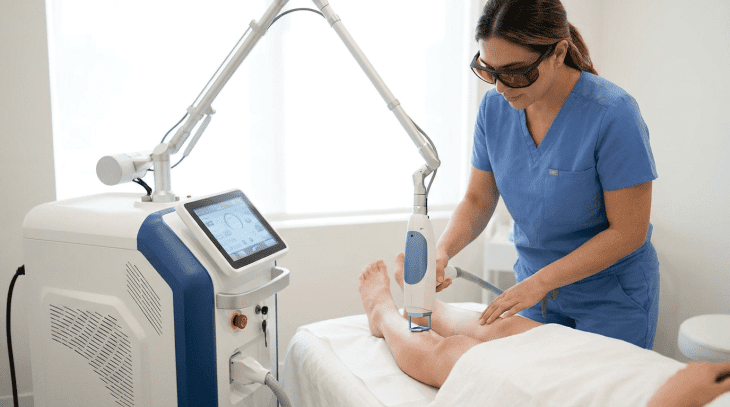
Nd:YAG laser hair removal uses a 1064 nm wavelength that reaches deeper than any other hair removal laser, which makes it the safest option for dark and tanned skin while still delivering lasting hair reduction. It is the technology we use exclusively at Esthetica Medspa, and this guide explains how it works, who it suits, what it costs, and what results to expect.
The essentials
- Nd:YAG stands for neodymium-doped yttrium aluminum garnet, the crystal that generates the laser’s 1064 nm beam.
- Its long wavelength bypasses melanin at the skin’s surface, which is why it is the reference laser for Fitzpatrick skin types IV-VI.
- Most patients need 6-10 sessions spaced 4-8 weeks apart, depending on the area and hair density.
- The American Academy of Dermatology reports laser hair removal typically reduces hair by 10-25% per session, with results building over the series.
- Nd:YAG devices for hair removal are FDA-cleared for permanent hair reduction. Results vary by hair color, hormones, and skin type.
What is an Nd:YAG laser?
An Nd:YAG laser is a solid-state laser that produces light at a wavelength of 1064 nanometers, roughly 30-50% longer than the wavelengths used by older hair removal lasers. That single number explains almost everything about why this technology behaves differently on skin.
Lasers remove hair through selective photothermolysis: the light is absorbed by melanin, the pigment in the hair shaft, and converts to heat that disables the follicle. Shorter wavelengths, like the 694 nm ruby or 755 nm alexandrite, are absorbed strongly by melanin wherever they find it, including the melanin in your skin. That works acceptably when skin is very light and hair is very dark, but it creates real risk for anyone with more pigment in their skin.
The 1064 nm beam is absorbed by melanin far more weakly at the surface, so it passes through the epidermis with much less interaction and deposits its energy deeper, at the level of the follicle. The follicle still heats enough to be disabled, while the surface of the skin stays out of the line of fire. That is the core trade-off of Nd:YAG: slightly more energy is needed to treat the follicle, in exchange for a dramatically wider safety margin.
How does Nd:YAG compare to other hair removal lasers?
Every laser wavelength has a personality. Here is how the four main hair removal technologies compare:
| Laser | Wavelength | Penetration | Best skin types | Notes |
|---|---|---|---|---|
| Ruby | 694 nm | Superficial | I-II only | Largely retired; high risk on pigmented skin |
| Alexandrite | 755 nm | Shallow | I-III | Fast on light skin; risky for IV-VI |
| Diode | 800-810 nm | Moderate | I-IV | Versatile middle ground; caution on V-VI |
| Nd:YAG | 1064 nm | Deep | I-VI (all) | Reference standard for dark and tanned skin |
Notice the last column: Nd:YAG is the only wavelength considered appropriate for all six Fitzpatrick skin types. That is why practices that serve every skin tone, including ours, standardize on it. If you have deeper skin and want the full picture of what safe treatment looks like, our guide to laser hair removal for dark skin goes area by area.
One honest caveat: on very light, fine, or gray hair, no laser performs well, because there is little melanin in the hair to absorb energy. If that describes your hair, electrolysis may be the better tool, and a consultation will tell you before you spend money on the wrong technology.
Is Nd:YAG laser hair removal safe?
Yes, when performed by a trained provider on an FDA-cleared device with settings matched to your skin type. The 1064 nm wavelength’s weak surface absorption is precisely what protects the epidermis, and modern devices pair the beam with contact or cryogen cooling that shields the skin further.
The American Academy of Dermatology emphasizes that the skill of the person performing laser hair removal matters as much as the device. At a consultation you should expect a Fitzpatrick skin type assessment, a review of your medications and history, and ideally a patch test on a small area before a full session. Typical temporary side effects include redness, mild swelling around follicles, and a sunburn-like sensation for a few hours to a couple of days.
Two practical safety rules apply to everyone. First, arrive untanned: recent sun exposure raises the melanin load in your skin and narrows the safety margin of any laser. Second, shave the area 24 hours before your session rather than waxing or plucking, because the laser needs the hair shaft in the follicle to work.
How many sessions does Nd:YAG hair removal take?
Plan on 6-10 sessions for most areas, spaced 4-8 weeks apart. Lasers only disable follicles in their active growth phase, and at any moment just a fraction of your hair is in that phase, so the series is spread out to catch each follicle at the right time.
| Area | Typical sessions | Spacing |
|---|---|---|
| Underarms | 6-8 | 4-6 weeks |
| Bikini or Brazilian | 8-10 | 4-6 weeks |
| Legs | 8-10 | 6-8 weeks |
| Face (upper lip, chin) | 8-12 | 4-6 weeks |
| Back or chest | 8-10 | 6-8 weeks |
The AAD notes that each session typically reduces hair by 10-25%, and reduction compounds across the series. Hormonally driven hair, such as facial hair related to PCOS, often needs a longer series plus occasional maintenance; we cover that in our PCOS laser hair removal service page.
How much does Nd:YAG laser hair removal cost?
Per-session pricing for Nd:YAG is the same as laser hair removal generally, since the wavelength is a clinical choice rather than a premium add-on. In the US, typical per-session ranges run from about $100-$250 for small areas like the upper lip or underarms, to $300-$600 for large areas like full legs or a full back. Package pricing for a series of 6-8 sessions usually brings the per-session price down meaningfully.
Commercial interest in this technology is real: “nd:yag laser hair removal” is searched about 3,600 times per month in the US with a $15.01 average CPC (DataForSEO, July 2026), which tells you how competitive the space is. Use that to your advantage: compare providers on technology, credentials, and results photos rather than on teaser prices. If you are budgeting for larger treatment plans, our breakdown of full body laser hair removal cost shows how areas combine.
What results can you expect, and are they permanent?
Nd:YAG devices are FDA-cleared for permanent hair reduction, which has a precise meaning: a lasting decrease in the number of hairs that regrow after a full treatment series, not a guarantee that every hair is gone forever. In practice, most patients finish a series with roughly 75-90% less hair in the treated area, and what regrows tends to be finer and lighter.
Results build on a predictable arc. Between sessions one and three you will notice patchy shedding and slower regrowth. By mid-series, most patients are shaving occasionally instead of daily. After the full series, many need only an annual touch-up, if anything. Hormones, genetics, and hair color all influence where you land on that curve, which is why we set expectations honestly at the consultation rather than promising a number.
How should you prepare for an Nd:YAG session?
Good preparation makes each session both safer and more effective. In the two weeks before your appointment, avoid sun exposure, tanning beds, and self-tanner on the treatment area. In the four weeks before, skip waxing, plucking, and threading, since the laser needs the hair root in place; shaving is fine and is actually required the day before your session so the energy goes into the follicle instead of surface hair.
On the day itself, arrive with clean, product-free skin: no lotions, deodorant, or makeup on the area being treated. Tell your provider about any new medications, since some antibiotics and retinoids increase light sensitivity. After the session, expect mild redness for a few hours, apply SPF 30+ daily, and avoid hot tubs, saunas, and intense workouts for 24-48 hours while the skin settles. Simple habits, but they are what keep a treatment series on schedule and side effects at the level of a footnote.
Why choose a med spa that uses Nd:YAG exclusively?
Many clinics own one laser and treat everyone with it, whatever their skin type. That business model works until a Fitzpatrick V patient is treated with a wavelength that was never right for them. We standardized on Nd:YAG across our laser hair removal services because it lets us treat every patient who walks in, from the fairest to the deepest skin tones, with the same safety margin.
Our providers are trained specifically on 1064 nm protocols: fluence selection by skin type, cooling management, and patch testing. You will see before-and-after photos from patients whose skin looks like yours, not just stock images. And because the same laser handles every area, your plan can combine face, underarms, bikini, and legs without switching devices or providers mid-series.
Frequently asked questions
Is Nd:YAG the best laser for dark skin?
Yes. Its 1064 nm wavelength interacts weakly with surface melanin, making it the reference standard for Fitzpatrick types IV-VI. It treats lighter skin safely as well.
Does Nd:YAG laser hair removal hurt more than other lasers?
Sensation is often described as a quick rubber band snap with brief heat. Because 1064 nm penetrates deeper, some patients feel it slightly more than an alexandrite pulse, but built-in cooling keeps it very tolerable. Numbing cream is available for sensitive areas.
How many Nd:YAG sessions will I need?
Most areas need 6-10 sessions spaced 4-8 weeks apart. Facial and hormonally driven hair may need more, plus occasional maintenance.
Can I get Nd:YAG treatment with a tan?
Nd:YAG is the most tan-tolerant hair removal laser, but fresh sun exposure still narrows the safety margin. We recommend avoiding sun for two weeks before and after each session and wearing SPF 30+ daily.
Is Nd:YAG laser hair removal permanent?
It is FDA-cleared for permanent hair reduction. Most patients see a lasting 75-90% decrease after a full series, with finer, lighter regrowth. Individual results vary, and occasional touch-ups are normal.
Does Nd:YAG work on blonde or gray hair?
Poorly, like all lasers, because light hair lacks the melanin the laser targets. Electrolysis is usually the better option for blonde, red, or gray hair.
Looking for Nd:YAG laser hair removal near you? Esthetica Medspa treats all skin types with Nd:YAG technology at every location. Book a free consultation and get a skin type assessment, a patch test, and a session plan built for your hair and your goals.

