
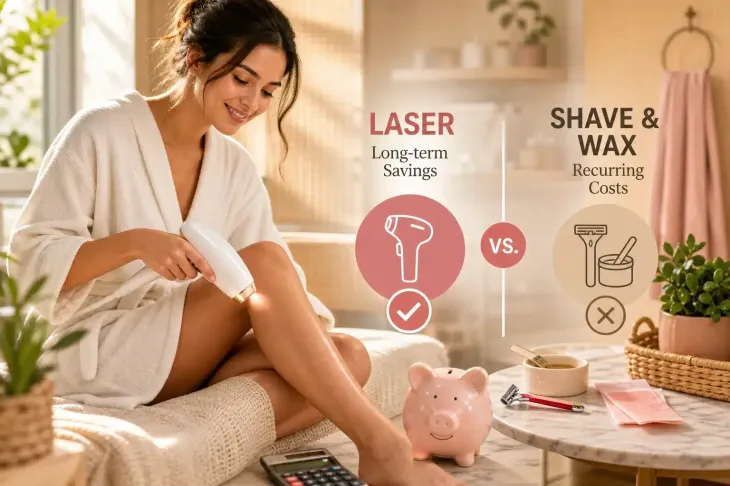
If you shave every two to three days, you already know the drill: the five-minute routine that never actually ends, the razor burn on your bikini line, the stubble that reappears before the weekend. If you wax, you know the other version, scheduling appointments every four weeks, 13 times a year, for the foreseeable future. Both methods work, technically. Neither one solves the problem.
This article breaks down the real laser hair removal benefits over shaving and waxing across four things that actually matter: how long results last, how much time you invest over the years, what it costs across a lifetime, and what each method does to your skin. After working with clients at Esthetica Medspa for many years and observing consistent patterns across thousands of treatments, I’ve seen those patterns repeat with remarkable consistency. Most people significantly underestimate what shaving and waxing cost them in both time and money once you zoom out past the next appointment, and the gap is wider than most expect.
By the end of this, you’ll have the numbers and the clinical context to make a confident decision, not just a gut feeling.
How Long Results Actually Last: Laser vs. Shaving and Waxing
Shaving, waxing, and laser don’t just differ in degree, they operate on completely different biological timelines. Shaving cuts the hair shaft at the surface of the skin. The follicle underneath remains completely intact, which is why you can see regrowth within 24 to 48 hours on most areas. There is no cumulative benefit from years of shaving. The follicle never changes, and the cycle never slows down.
Waxing pulls hair from the root, which buys you three to four weeks of smoothness before the follicle regrows on schedule. Repeated waxing can cause the hair to grow back slightly thinner over time due to root trauma, but it does not achieve semi-permanent or permanent reduction. The four-week cycle simply continues indefinitely. You’re not making progress toward a finish line; you’re running on a treadmill.
Laser works differently at a structural level. It targets the hair follicle itself with concentrated light energy, disrupting the growth cycle at the source rather than trimming or pulling the hair above it. After a series of six to eight sessions spaced four to eight weeks apart, with some areas or hair types requiring up to ten sessions depending on density and skin tone, most clients see significant reduction in hair density. Many clients maintain those results for one to three years between touch-ups, with some areas showing permanent reduction. Occasional touch-up sessions may be needed over time, but the frequency of hair removal drops dramatically compared to either shaving or waxing.
The Time Cost You’re Probably Not Adding Up
The financial comparison gets a lot of attention, but the time argument is just as compelling. Consider a typical shaving routine covering legs, underarms, and bikini line: at roughly 15 to 20 minutes per session, three to four times per week, that adds up to more than 50 hours per year as an illustrative estimate. Over a decade, that’s a significant block of time spent on a task that produces no lasting result.
Waxing is less frequent but carries its own overhead. Thirteen appointments per area per year, factoring in travel, wait time, and the appointment itself, can represent a substantial time commitment, roughly 30 to 40 hours annually for someone waxing three areas based on typical appointment lengths of 30 to 60 minutes plus round-trip travel. You’re also constrained by the growth cycle: you have to let hair grow long enough to wax, which means living with stubble for a portion of every month.
Clients who complete a full laser series at Esthetica Medspa regularly tell us at follow-up appointments that they’ve reclaimed a significant portion of their weekly grooming time compared to their previous routine. After completing treatment, most reduce their grooming to a few minutes monthly or less. That’s not a marketing claim; it’s what clients describe at follow-up appointments when they reflect on the shift. The treatment sessions themselves require time upfront, but that investment has a defined endpoint. Shaving and waxing don’t.
Where the Time Savings Compound Most
The areas where clients report the most noticeable time savings are legs, underarms, and the bikini line, precisely the areas that require the most frequent attention with shaving and the most uncomfortable appointments with waxing. Once laser treatment is complete for those areas, grooming becomes largely incidental rather than a scheduled obligation. For people specifically weighing options for the bikini area, our guide to bikini laser hair removal outlines what each option covers, sessions and cost.
Many readers find it helpful to see concrete estimates of time lost to routine shaving; blogs that quantify that time can make the comparison more tangible when you’re deciding whether to invest in a finite course of laser treatments. For example, analyses of how much time you waste shaving your legs illustrate the cumulative hours involved in regular shaving and help explain why clients often describe feeling like they’ve “gotten their weekends back” after completing laser.
The Lifetime Cost Math: Laser Hair Removal Benefits Over Shaving and Waxing
The most common objection to laser hair removal is the upfront cost, and it’s a fair one. A session for underarms runs roughly $70 to $230; full legs range from $250 to $500 per session; most areas require six to ten sessions total. Depending on how many areas you’re treating, the full investment typically falls between $800 and $4,500. That’s real money, and it’s worth taking seriously.
What’s also worth taking seriously is the 30-year math on the alternatives. Waxing one area at $60 per session, 13 times per year, over 30 years adds up to roughly $23,400 for that single area alone. Brazilian waxing in higher-cost markets can exceed $36,000 over the same period. When you factor in lifetime tallies of razors, shaving cream, and aftercare products, out-of-pocket shaving costs frequently exceed $23,000 when calculated across decades. When you stack those numbers next to a one-time laser investment, laser often costs less than 10% of what you’d spend on waxing or shaving over a lifetime.
The break-even point typically lands between 14 and 18 months after starting laser, a figure consistent with cost-analysis breakdowns when you compare per-session laser pricing against ongoing waxing or shaving expenditures. Every year after that is net savings. Full-body waxing over 30 years can exceed $55,000 when you include all treated areas; a comparable laser investment sits closer to $5,500 to $6,600 including periodic touch-ups. The gap compounds significantly over time. For straightforward breakdowns of typical pricing and what to expect for budgeting, resources that cover how much laser hair removal costs are useful when you plan finances and compare package deals versus à la carte sessions.
Cost Breakdown by Treatment Area
Not every area carries the same price tag or the same payoff timeline. Underarms and the bikini line tend to have the fastest break-even periods because waxing those areas is both frequent and costly. Legs take longer to pay off due to higher per-session laser pricing, but the long-term savings are proportionally larger. A provider should walk you through this math area by area during your consultation so you can prioritize based on your own habits and budget.
Pain and Skin Effects: Laser vs. Shaving and Waxing
Shaving is painless during the process. The problems come after: razor burn, nicks, and ingrown hairs are chronic side effects for regular shavers, not occasional ones. Cutting hair at the skin’s surface leaves a sharp edge that curls back into the follicle, especially on sensitive areas like the bikini line and underarms. For people with coarser or curlier hair, ingrown hairs from shaving can be a persistent, frustrating issue that compounds with every session.
Waxing is the most acutely painful of the three methods, consistently rated high on pain scales due to the prolonged pulling sensation. Folliculitis (inflammation of the hair follicles) can follow waxing sessions, particularly on sensitive skin. Repeated trauma to the same skin areas over years can lead to lasting redness or uneven texture, especially for clients who wax frequently.
Laser falls in the middle on pain. Most clients describe a brief, warm snap per pulse, similar to a rubber band flicking the skin, typically rated two to four out of ten on most body areas. Sensitive areas like the bikini line and upper lip can reach six to seven. Most modern laser systems include built-in cooling to reduce discomfort during treatment. Temporary redness and mild swelling typically resolve within a few hours, and serious side effects like burns or discoloration are rare when the correct laser system is matched to the client’s skin tone by a trained provider. If you’re treating the bikini area specifically, our Brazilian laser hair removal treatment & aftercare guide covers practical post-treatment steps to minimize irritation and speed recovery.
Perhaps most importantly, laser significantly reduces ingrown hair rates by disrupting the follicle rather than cutting or pulling the hair shaft. Clinical data consistently show reduction rates of 75 to 95% following a complete series, which directly translates to a dramatic decrease in ingrown hairs for most clients, a meaningful quality-of-life improvement that shaving and waxing simply cannot replicate. For patient-centered explanations about how laser addresses ingrown hairs, resources on laser hair removal for ingrown hair provide useful context.
Who Gets the Best Results from Laser Hair Removal
Modern laser systems have expanded the candidate pool considerably, but knowing which system is right for your skin tone and hair color matters both for safety and for setting realistic expectations. The underlying principle is contrast: laser targets melanin, so the greater the difference between hair follicle pigment and skin tone, the more precisely the energy is absorbed at the follicle.
Dark, coarse hair on light skin remains the most efficient combination, and Alexandrite (755 nm) or diode (810 nm) lasers deliver excellent results for Fitzpatrick skin tones I through III. For medium to darker skin tones, Fitzpatrick IV through VI, the right system matters critically. Nd:YAG at 1064 nm is the clinically appropriate choice for deeper skin tones because its longer wavelength bypasses surface melanin and targets the follicle directly. Standard IPL and Alexandrite lasers carry a real risk of hyperpigmentation and burns on darker skin and should be avoided. Clients with darker skin tones may need up to 10 sessions rather than the typical six to eight, but results are absolutely achievable with the right system and a provider who understands the distinction.
Light, blonde, gray, or red hair lacks sufficient melanin in the follicle for any current laser system to achieve reliable results. If that describes your hair color, electrolysis is the recommended alternative and delivers permanent results regardless of hair color. Knowing this before you book a consultation saves you time and money, and any credible provider will tell you the same thing upfront.
Practical Steps Before Your First Laser Session
If laser sounds like the right move, the next step is a consultation, not a commitment. A thorough consultation is a clinical assessment where your provider evaluates your skin tone, hair color, treatment areas, and any relevant medical history to build an accurate treatment plan. At Esthetica Medspa, consultations are complimentary, the treatment plan should be built around your specific anatomy and goals, not a generic package.
There are a few questions worth bringing to any consultation. Ask which laser system the provider uses and why it’s appropriate for your skin tone. Ask for a realistic session estimate by area, not just a range. Ask about pricing structure, whether packages are available, and what payment options exist. If a provider can’t explain the reasoning behind their equipment choice or gives vague answers about session counts, that’s useful information.
Preparation on your end directly affects both safety and results. Avoid sun exposure and self-tanner for at least two weeks before your first session, as tanned skin increases the risk of adverse reactions. Shave the treatment area 24 hours before your appointment, but do not wax or pluck beforehand, the follicle must be intact for laser energy to reach the target. If you’re taking medications that increase photosensitivity, discuss these with your provider at the consultation stage. These steps are straightforward, but skipping them can affect both how comfortable your session is and how effective it will be. If you’re planning treatments around warmer months, our article on when to start before summer can help you schedule a series so you’re hair-free for the season.
The Bottom Line on Switching to Laser
Shaving and waxing are temporary solutions to a permanent problem, and the cumulative cost of both methods, measured in hours and dollars, is substantially higher than most people realize until they sit down and calculate it. When you weigh the full laser hair removal benefits over shaving and waxing, the math is hard to argue with: laser typically pays for itself within 18 months and eliminates the ongoing time and maintenance burden for years afterward. For a concise summary of practical advantages over shaving, see an accessible roundup of reasons why laser hair removal is better than shaving.
The right candidate, the right laser system, and a provider with genuine clinical expertise determine your results. That combination is worth choosing carefully. At Esthetica Medspa, every client starts with a complimentary consultation designed to answer exactly those questions: which system fits your skin tone, how many sessions are realistic for your treatment areas, and what your personalized protocol will look like from start to finish.
If you’re ready to stop calculating the next wax appointment and start calculating the last one, a free consultation is the logical first step. Reach out to Esthetica Medspa to book yours and get a clear picture of what laser hair removal would actually look like for you.

